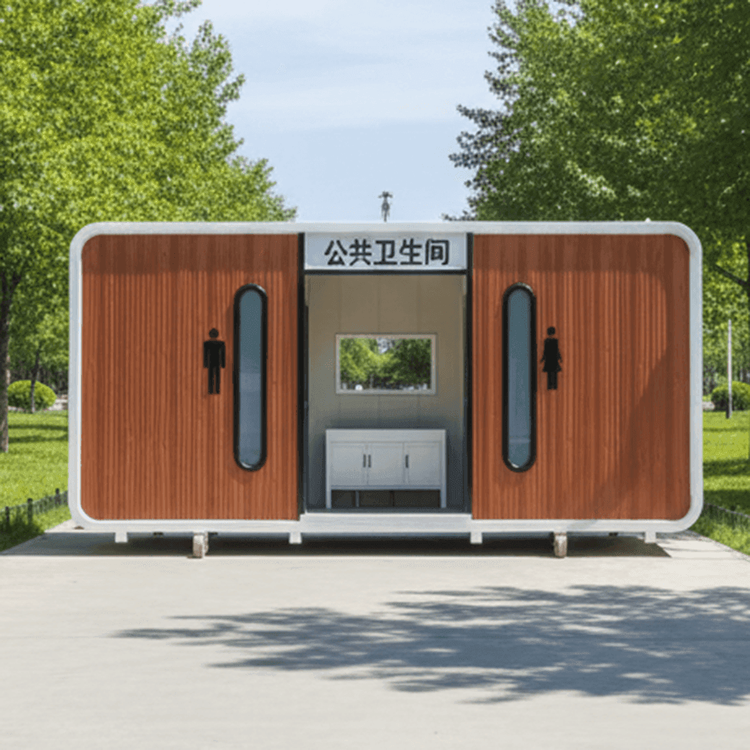
Prospects of Prefabricated Housing in the Civilian Sector
Prefabricated housing holds broad development prospects in the civilian sector, primarily reflected in market demand, policy support, technological innovation, cost efficiency, international markets, and regional potential.

Strong Market Demand
Accelerated global urbanization and population growth are driving a surge in housing demand, particularly for flexible and efficient housing solutions. In 2024, the global market size for prefabricated housing reached $156 billion, with particularly prominent demand in the Asia-Pacific region (such as China and India). It is expected to maintain double-digit growth in the coming years. This trend provides a market foundation for the popularization of prefabricated housing in the civilian sector.Policy Support and Green Building Trends
Through policies such as the '14th Five-Year Plan for Energy Efficiency and Green Building Development in the Construction Sector,' China explicitly promotes prefabricated and green buildings. Prefabricated housing aligns with policy directions due to its advantages in energy conservation, environmental protection, and short construction periods. For example, its production process reduces construction waste and carbon emissions, in line with the 'dual carbon' goals, providing policy guarantees for its application in the civilian sector.Technological Innovation Enhances Competitiveness
The integration of modular design, 3D printing technology, and the Internet of Things (IoT) makes prefabricated housing more intelligent and cost-effective. For instance, the E-MIC prefabricated concrete box house optimizes module layout, reducing module usage by 30%-40% while improving space utilization and construction speed. It is suitable for scenarios such as urban renewal and new residential construction, significantly enhancing market adaptability.Significant Cost and Efficiency Advantages
Compared to traditional construction, prefabricated housing can shorten construction periods by over 60%, reduce on-site labor by about 50%, and lower noise and dust pollution. For example, a social housing project in Shenzhen, Guangdong Province, adopted concrete module assembly, reducing the construction period from 2.5-3 years to 1 year, demonstrating outstanding cost-effectiveness, especially suitable for large-scale civilian projects like social housing.Accelerated Expansion into International Markets
Chinese prefabricated housing companies (such as Broad Homes and Zhongjian Hailong) are actively exploring overseas markets with green and economical design concepts. For example, the E-MIC housing system has engaged in negotiations with multiple countries for cooperation, promoting the globalization of green construction concepts and meeting global demand for efficient housing, further expanding the application boundaries in the civilian sector.Huge Regional Market Potential
Economically developed regions in China, such as East China, South China, and North China, are the main markets for prefabricated housing, while the central and western regions show significant growth potential. In 2024, the combined market size in the central and western regions reached 45.5 billion yuan, with a year-on-year increase of 13.5%, indicating that the regional coverage of prefabricated housing in the civilian sector is expanding.
You may also like
Portable Toilet Furnishing Buying Guide: Options & Tips
Read More
Portable Toilet In Stock Custom & OEM: Design & Bulk Production Guide
Read More
How to Source Portable Toilet Rental Wholesale from China
Read More