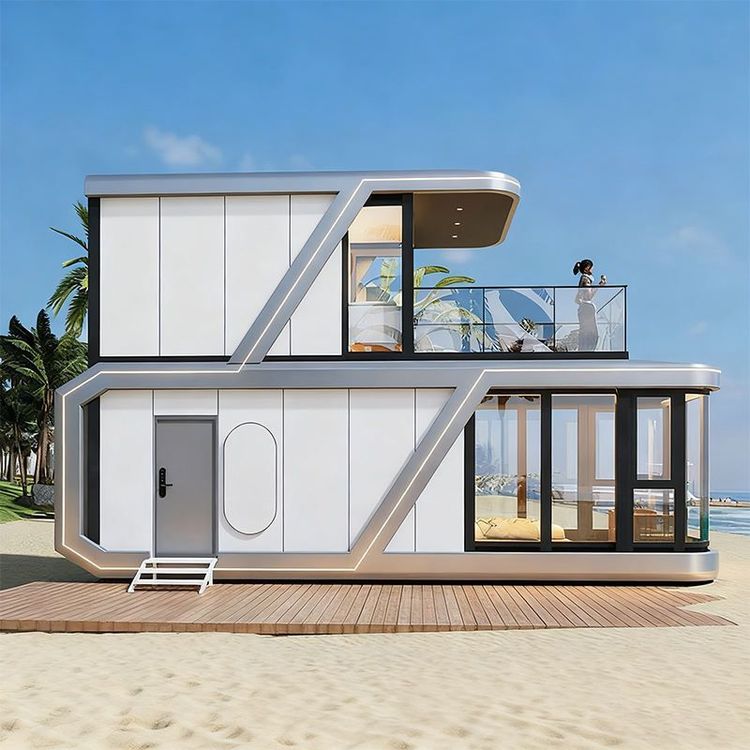
Prefabricated Concrete Houses
Prefabricated concrete houses are a form of construction that utilizes industrialized production of building components, which are then assembled on-site. They are characterized by rapid construction speed and diverse types, but have not become widespread in rural areas.

Definition and Construction Characteristics
Prefabricated concrete houses, also known as prefabricated assembled buildings, have their main structures pre-cast into various concrete components in factories. During construction, these components are connected like building blocks, significantly reducing on-site wet operations and enabling rapid construction. For example, a two-story reinforced concrete shell house can be completed in approximately two weeks.
Main Types and Technical Scope
- Main Types: These include panel-assembled, box-assembled, and frame-assembled types. Panel-assembled types use pre-cast wall panels and floor slabs as core components, allowing for expanded usable area but limited design flexibility. Box-assembled types combine pre-fabricated functional units, increasing construction speed by 50%-70%, but requiring higher transportation and lifting equipment. Modular buildings represent a more integrated model.
- Technical Scope: This encompasses both prefabricated concrete structures and steel structures, with components including pre-cast beams, slabs, walls, and columns.
Development History
China's prefabricated concrete technology began in the 1950s, initially used for factory and residential construction. In the 1970s, driven by the policy of "industrialization, standardization, and mechanization" in construction, technical systems such as large-panel structures and box structures were formed. By the mid-1980s, the technology stagnated due to cost and quality issues. However, in the 21st century, it has revived due to production efficiency and environmental advantages. Companies like Vanke Group have developed prefabricated shear wall residential structural systems and applied prefabricated frame technology in engineering projects.
Situation in Europe, America, and China
- European and American Countries: Prefabricated houses are popular. Taking Chinese-exported prefabricated houses to Europe and America as an example, the houses are divided into modules, produced on assembly lines, packed, and shipped abroad. On-site assembly is simple, with water pipes and electrical wires pre-installed, offering complete functionality and affordable prices. In the first four months of 2026, Guangzhou Customs reported exports of movable houses worth 1.4 billion yuan, a year-on-year increase of 38.1%.
- Rural China: Prefabricated houses have not become widespread. On one hand, the cost of rural self-built houses is not significantly different from that of prefabricated houses, and people prefer to build their own homes. On the other hand, compared to better self-built houses, prefabricated houses are of lower quality, with less stable structures and a tendency for cracks and water leakage at module connections. They are mostly used as temporary solutions, commonly seen on construction sites.