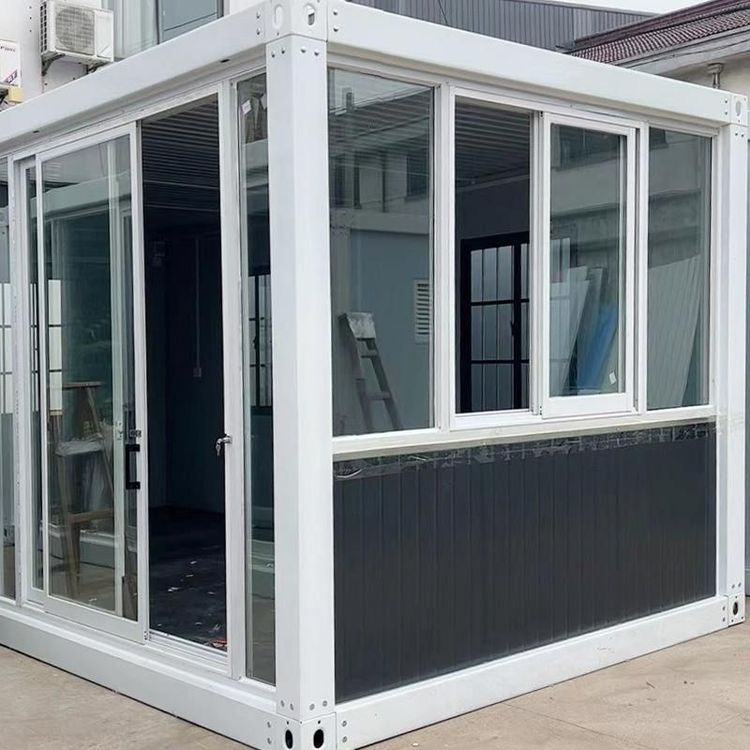
Prefabricated Assembled Cement House Roof
The prefabricated assembled cement house roof is a roofing form that uses factory-prefabricated cement components, which are assembled and installed on-site. Its technical principle is similar to that of prefabricated buildings, featuring efficient construction and low costs. However, it has potential issues such as poor sound insulation, water leakage, and weak earthquake resistance. It is mostly used in rural self-built houses and temporary buildings, with a service life of approximately 30-50 years.

Technical Principles and Construction Characteristics
The core components of the prefabricated assembled cement house roof (such as walls and floor slabs) are cast and formed in factories using high-precision molds, integrating structural elements like steel reinforcement skeletons and insulation layers to ensure the strength and functionality of the components. During on-site installation, the components are connected via bolts or welding to form an overall framework, eliminating the need for on-site concrete pouring and significantly shortening the construction period. For example, a single 30㎡ roof module can be prefabricated in the factory in just 7 days and installed on-site in a few hours, making the construction efficiency much higher than that of traditional cast-in-place processes.
Advantages and Limitations
Advantages:
- High Construction Efficiency: The separation of factory prefabrication and on-site installation reduces the impact of weather on construction, and the modular design facilitates rapid assembly.
- Lower Costs: Standardized production reduces material waste, and both labor and time costs are lower than those of cast-in-place structures.
Limitations:
- Structural Issues: Since the prefabricated panels are assembled from independent sections, gaps between sections may lead to poor sound insulation and water leakage.
- Weak Earthquake Resistance: The overall integrity is inferior to that of cast-in-place structures, making them prone to collapse due to connection node failures during earthquakes.
- Variable Quality: There is a significant quality variation in prefabricated panels on the market. Poor-quality products may suffer from issues such as steel reinforcement corrosion and concrete carbonization, leading to a shortened service life (approximately 30-50 years) and even safety accidents.
Application Scenarios and Policy Orientation
Currently, prefabricated assembled cement house roofs are mostly used in rural self-built houses, temporary buildings (such as construction site dormitories and post-disaster relief housing), and other scenarios that are sensitive to costs and have low earthquake resistance requirements. Since 2022, China has implemented renovation policies focusing on repairing and upgrading prefabricated panel houses, primarily addressing issues like water leakage and insulation. Only buildings that meet the criteria for dangerous houses are demolished, rather than a complete phase-out. This policy reflects the need to balance cost-effectiveness and safety in prefabricated panel houses.
Usage Recommendations
If choosing a prefabricated assembled cement house roof, it is essential to strictly control the quality of the components, prioritize products that have passed earthquake resistance tests, and enhance waterproofing and sound insulation between panels (such as filling with sealant and adding sound insulation layers). Additionally, regularly inspect the connection nodes and structural stability to extend the service life and reduce safety risks.