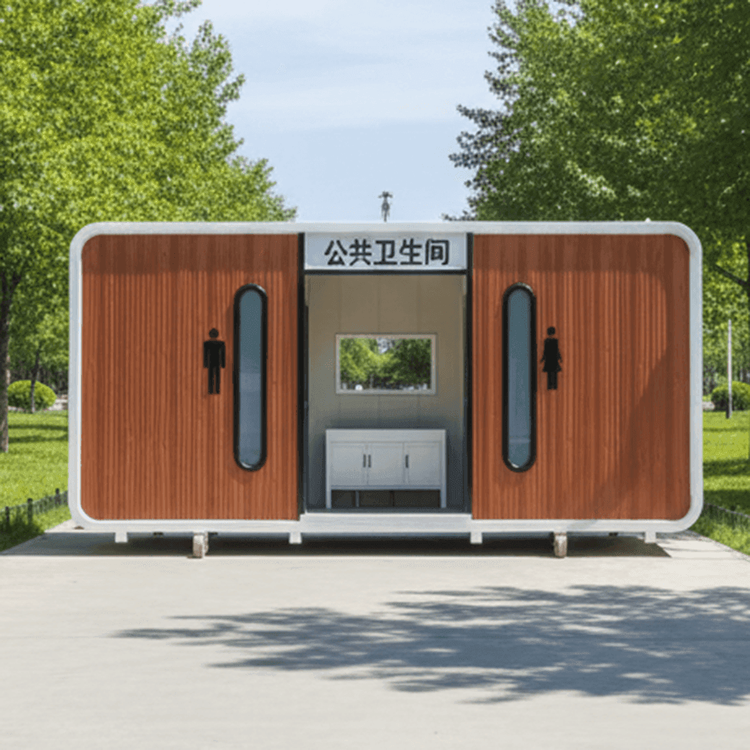
Zipper-Type Mobile Toilet Structure
Currently, there is no direct mobile toilet design with 'zipper' as the core structure, but there are innovative examples of modular portable mobile toilets whose structures can provide references.

Typical Structure of Modular Portable Mobile Toilets
Taking the Minimilet mobile toilet backpack designed by the Japanese studio Nendo as an example, its structure combines portability and functionality through modular design, mainly including the following parts:
- Support Frame: Four foldable aluminum tubes are used as the main support structure. They are assembled to form a stable frame, ensuring strength while facilitating storage.
- Seat Cushion and Privacy Protection: Equipped with a C-shaped seat cushion that conforms to ergonomic design, enhancing user comfort. The outer layer is a quickly deployable tent that is fixed with zippers or buckles, creating an independent and private space.
- Functional Components: Built-in tissues, garbage bags, and coagulants. The coagulants are used to treat excrement, reducing odors and facilitating subsequent cleaning. The garbage bags serve as temporary waste containers, enabling waterless operation.
- Portability Design: All components can be stored in a backpack, with a light total weight, making it easy to carry to outdoor or emergency scenarios.
Structural Characteristics of Traditional Mobile Toilets
Although traditional mobile toilets do not adopt a zipper-type design, they achieve functional integration through modular structures. Typical structures include:
- Main Frame: Mostly use steel or aluminum alloy frames to ensure overall stability. Some designs improve transportation efficiency through detachable structures.
- Waste Storage System: Divided into direct-discharge and recycling types. The direct-discharge type relies on external sewage pipes, while the recycling type uses biodegradation or chemical treatment technologies to treat waste on-site.
- Ventilation and Lighting: Ventilation openings or exhaust fans are installed on the top, along with lighting equipment, to optimize the user experience. Some high-end models are also equipped with air conditioning systems.
Potential Application Directions of Zipper-Type Structures
If zippers are introduced into mobile toilet design, they may be applied in the following scenarios:
- Quick Assembly: Connect tent or shell modules with zippers, reducing the use of screws and other fasteners and improving assembly efficiency.
- Sealing Optimization: Use zippers for sealing at waste storage containers or pipe joints to prevent leakage and simplify the cleaning process.
- Expandability: Design stretchable zipper structures to allow the toilet space to be flexibly adjusted according to needs.
Currently, zipper-type mobile toilets have not become mainstream, but modularity and portability remain the core development directions. In the future, functional breakthroughs may be achieved through material and structural innovations.
You may also like
Portable Toilet Furnishing Buying Guide: Options & Tips
Read More
Portable Toilet In Stock Custom & OEM: Design & Bulk Production Guide
Read More
How to Source Portable Toilet Rental Wholesale from China
Read More