
Wuhai Solar-Powered Mobile Toilet
The Wuhai solar-powered mobile toilet is an environmentally friendly mobile toilet that combines solar power supply with efficient pollutant treatment technology, adapts to complex terrains, and has rapid deployment capabilities. The following provides an introduction from four aspects: power supply system, pollutant treatment, energy self-sufficiency rate, and deployment capability.
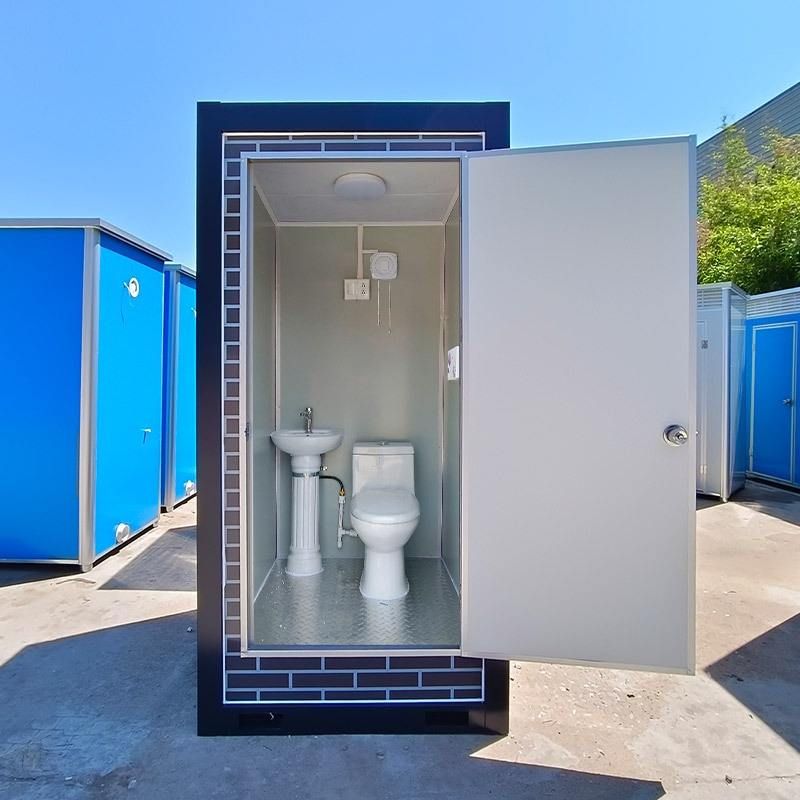
In terms of the power supply system, the Wuhai solar-powered mobile toilet uses a solar power system. It collects solar energy through solar panels and converts it into electrical energy to power the entire toilet. This design enables it to adapt to complex terrains without relying on traditional municipal power supplies. It can function normally in remote areas or places with underdeveloped power infrastructure, greatly expanding its range of applications.
Regarding pollutant treatment technology, this mobile toilet adopts a three-stage separation design. Among them, the second-stage biological degradation process is a key innovation. It utilizes thermophilic bacteria to degrade organic matter in a temperature-controlled environment. This process does not require additional water sources, reducing water consumption and aligning with environmental protection concepts. At the same time, through the action of thermophilic bacteria, methane emissions are reduced by approximately 78%, effectively minimizing greenhouse gas emissions and having a positive impact on environmental protection.
In terms of the energy self-sufficiency rate, the entire system can achieve an energy self-sufficiency rate of up to 92%. This means that under normal usage conditions, the solar power system can meet most of the energy needs of the mobile toilet, requiring only a small amount of external energy supplementation or no supplementation at all. This reduces operating costs and improves energy utilization efficiency.
Regarding deployment capability, the Wuhai solar-powered mobile toilet has integrated and rapid deployment capabilities. It does not rely on complex municipal interfaces. With its self-contained water storage tanks, septic tanks, or biological treatment units, it can complete the entire process from transportation to functional activation within a few hours. This rapid deployment capability gives it significant advantages in places that require temporary toilets, such as emergency rescue situations, large-scale events, and tourist attractions, enabling it to quickly meet people's toilet needs.



