Why Container House Material Matter: A Quick Guide
The importance of container house materials is reflected in four aspects: sustainability, durability, flexibility, and assembly efficiency, directly affecting building performance and ecological benefits.

1. Sustainability: Reducing Resource Consumption and Carbon Emissions Container houses transform discarded steel from retired shipping containers into building structures through reuse, directly reducing embodied carbon emissions. Traditional construction requires mining new ores and processing them into steel, whereas the recycling of containers avoids this process while also reducing landfill waste. This concept aligns closely with the principle of "maximizing the potential of existing materials" emphasized in Why Materials Matter, embodying the core tenets of a circular economy. Additionally, some container houses utilize renewable materials like reclaimed wood and bamboo for interior finishes, further lowering environmental impact.
2. Durability and Structural Integrity: Ensuring Long-Term Safety The main structure of container houses relies on high-strength steel, combined with sandwich panels (e.g., rock wool core panels) to form composite walls that ensure structural strength while maintaining indoor air quality through breathable design. To withstand harsh environments, some projects employ galvanized steel frames and waterproof sandwich panels to enhance corrosion resistance. In coastal or high-humidity regions, the use of weathering steel (Corten Steel) creates a natural oxidation protective layer, extending service life to decades. This material combination ensures stability under extreme conditions like earthquakes or strong winds, complying with building safety codes.
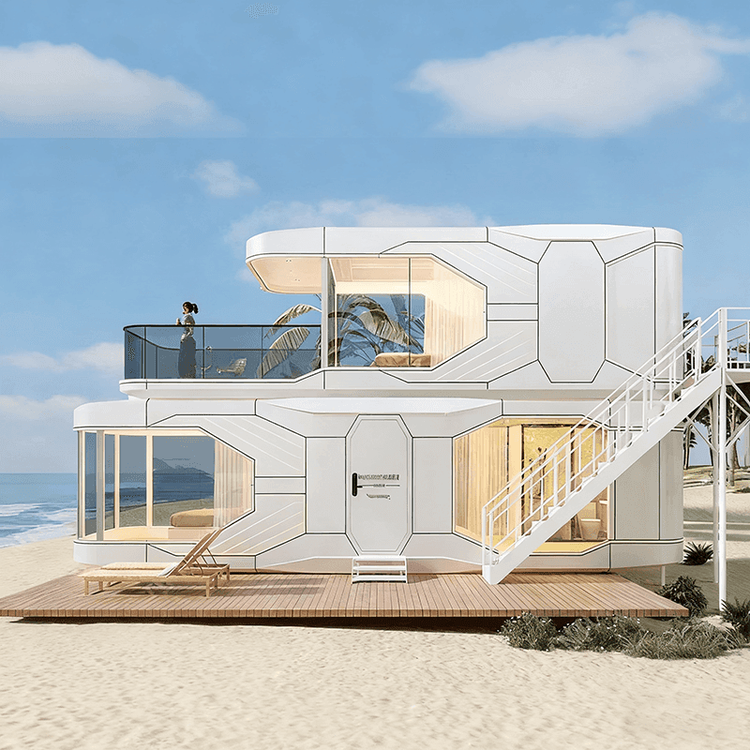
3. Flexibility and Adaptability: Meeting Diverse Needs Modular design grants container houses high customizability. By combining containers of different sizes (e.g., 20-foot and 40-foot standard units), spaces ranging from single-room dwellings to multi-story hotels can be rapidly constructed. For material selection, lightweight partitions (e.g., gypsum board, glass) divide interior functional areas, while removable panels facilitate later renovations. Integration of eco-materials like solar panels and rainwater harvesting systems enables adaptation to sustainable needs across climates. For instance, high-reflectivity coatings reduce heat absorption in deserts, while increased insulation thickness enhances energy efficiency in cold regions.
4. Rapid and Efficient Assembly: Shortening Construction Timelines Prefabrication is a core advantage of container houses. Key components like roofs, floors, and plumbing systems are assembled in factories, with on-site work limited to lifting containers and connecting modules—reducing construction time by 50%-70% compared to traditional buildings. This efficiency stems from material standardization and modular design: steel frames provide unified connection points, sandwich panels enable quick installation, and lightweight materials (e.g., aluminum doors/windows) reduce crane requirements. For example, a two-story container home can be assembled in 2-4 weeks, significantly cutting labor and time costs.