
House Prefabricated: What to Know Before You Buy
Before purchasing a prefabricated house, it is essential to understand its definition, production process, advantages, application scenarios, and material structure, as detailed below:

Definition and Production Process: Prefabricated houses are constructed by pre-manufacturing modules (such as walls, floors, roofs, or even entire rooms) in a factory, which are then transported to the site and assembled like building blocks. In the factory, robotic arms cut steel and pour concrete to ensure precise dimensions; walls are embedded with insulation materials, plumbing, and electrical wiring, and pre-installed with doors and windows, enabling a 'move-in ready' production process.
Core Advantages:
- Efficient Construction: For example, a 57-story apartment building in Changsha, Hunan, was constructed in just 19 days using prefabrication technology (compared to 2 years with traditional methods), making it particularly suitable for post-disaster reconstruction or cities with housing shortages.
- Environmental Protection and Energy Efficiency: Factories accurately calculate material usage, with waste being recyclable, reducing overall energy consumption by over 50%. Swedish companies have even achieved 'zero waste', with some houses equipped with solar panels and rainwater collection systems.
- Reliable Quality: Concrete is cured in temperature- and humidity-controlled workshops, resulting in higher strength than open-air pouring; Japanese prefabricated houses can withstand magnitude-9 earthquakes, while Nordic wooden houses remain warm at -30°C. Factory quality inspections are fully transparent, with data records covering welding, sound insulation, and other aspects.
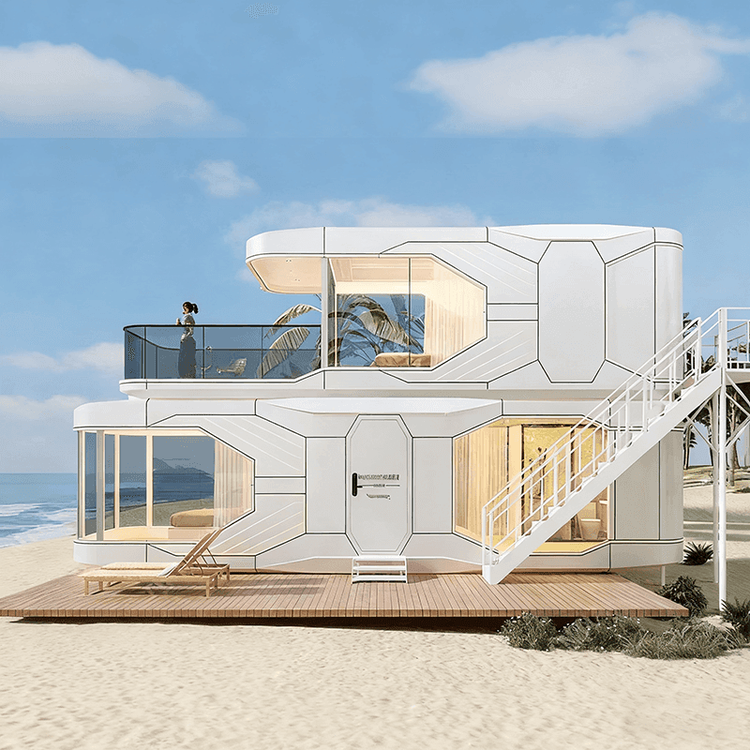
- Flexible Design: Modular combinations allow for diverse styles, such as a wave-roofed community center in the Netherlands and a detachable holiday home in Australia, breaking away from the stereotype of 'boxy' structures.
Application Scenarios: In addition to temporary housing, prefabricated houses are widely used for office buildings, mining camps, hotels, schools, villas, apartments, medical facilities (such as the container-style isolation wards built in 10 days at Wuhan's Huoshenshan/Leishenshan Hospitals during the COVID-19 pandemic), warehouses, greenhouses, and more. Their rapid installation and cost-effectiveness are particularly advantageous during special periods, such as pandemics.
Materials and Structure: The main structure often uses Q235B/Q345 steel, with walls and roofs made of sandwich panels (filled with materials like rock wool or polyurethane). Doors and windows are typically aluminum alloy or plastic-steel. A typical structure is a light steel frame container house, with door frames made of aluminum sandwich panels for a balance of strength and lightness.
You may also like
House For Sale Pricing: What You Need to Know
Read More
Portable Toilet Rendering Explained: How to Choose the Right One
Read More
Top Mobile Container House Manufacturers: How to Choose a Factory Partner
Read More