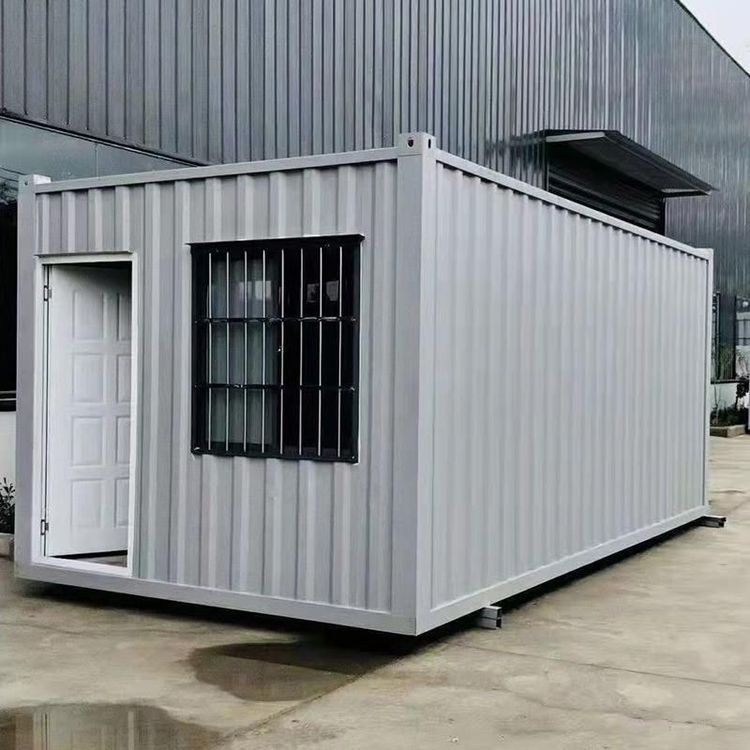
Why Container House For Sale Matter: A Quick Guide
The core reasons why container houses are gaining attention in 2026 lie in their cost-effectiveness, sustainability, and adaptability to modern lifestyles, which can be analyzed from the following five aspects:

1. Cost-Effectiveness: Alleviating Housing Cost Pressures
Global housing prices continue to rise faster than income growth, making the purchase threshold for traditional housing increasingly unfriendly to low- and middle-income groups. Container houses reduce construction costs to one-third to one-half of traditional homes through modular design and industrial production. Their core material—retired shipping containers—are inexpensive to purchase due to global trade surpluses and require no additional foundational building materials, further lowering initial investment. This cost-effectiveness shifts housing from an “investment product” back to its “residential attribute,” making it particularly suitable for first-time homebuyers or those with limited budgets.
2. Sustainability: Practices for Addressing the Climate Crisis
The traditional construction industry contributes approximately 40% of global carbon emissions, with building material production (e.g., cement and steel) accounting for a significant portion. Container houses directly reduce the demand for new steel production by reusing retired containers, lowering “embodied carbon” emissions. Meanwhile, modular construction generates over 70% less construction waste compared to traditional methods, and container structures are 100% recyclable, aligning with circular economy principles. Some projects also integrate green technologies like solar panels and rainwater harvesting systems, offering feasible solutions for “zero-carbon housing.”
3. Lifestyle Transformation: Flexibility and Versatility
The post-pandemic era has seen an expansion of “remote work” and “digital nomad” groups, driving demand for movable, rapidly adaptable living spaces. Container houses support “plug-and-play” deployment: a single module can be assembled in hours, while multiple modules can be stacked horizontally or vertically for space expansion. This flexibility allows them to serve as permanent homes, vacation houses, mobile offices, or Airbnb short-term rental units, meeting diverse usage scenarios. Additionally, their industrial aesthetic and customizable interiors attract young consumers seeking personalized living experiences.
4. Rapid Deployment and Modular Expansion: Meeting Urgent Needs
In areas prone to natural disasters or housing shortages, the standardized production and transport convenience of container houses become critical advantages. Individual modules can be independently transported to remote regions and quickly assembled using bolts without complex foundation work, significantly shortening construction timelines. For example, in post-disaster reconstruction projects, container houses can provide temporary shelter within 72 hours and later be upgraded to permanent homes by adding modules, unifying “transitional” and “long-term” functions.
5. Eco-Labels and Visual Appeal: Market Communication Effects
The “eco-friendly attributes” and “industrial aesthetics” of container houses create unique selling points, easily triggering viral effects in the social media era. Their exposed steel frames, geometric lines, and customizable color schemes break the homogeneity of traditional housing, making them representatives of “internet-famous architecture.” This visual impact not only attracts consumers but also prompts developers to use them as marketing tools for green projects, further driving market acceptance.