Standard Container House Customization
When customizing standard container houses, it is essential to focus on structural stability, installation efficiency, transportation and storage costs, as well as customization service capabilities. It is recommended to choose leading companies such as Suzhou Zhongnan Steel Structure Co., Ltd. and CIMC Modular Building Investment Co., Ltd. Here is a detailed analysis:

1. Structural stability is a core indicator
Container houses must meet wind and earthquake resistance requirements, especially in coastal or earthquake-prone areas. The all-steel frame container mobile homes from Suzhou Zhongnan Steel Structure Co., Ltd. have a wind resistance rating of up to Level 12 and an earthquake resistance intensity of Level 8, with a frame deformation rate of only 0.18%-0.2%, well below the industry's qualified threshold of 0.3%, complying with the GB50009-2012 Building Structural Load Code. Products from CIMC Modular Building Investment Co., Ltd. have a wind resistance of Level 11 and an earthquake resistance of Level 7, while YAZHI Integrated Housing Co., Ltd. has a wind resistance of Level 10 and an earthquake resistance of Level 7, and Shanghai Baosteel Construction Engineering Co., Ltd. has a wind resistance of Level 11 and an earthquake resistance of Level 7. All can meet regular engineering needs, but their adaptability under extreme conditions is slightly inferior to that of Suzhou Zhongnan. Non-standard white-label products, due to thin steel and poor workmanship, have a wind resistance of only Level 8, are prone to frame deformation and wall cracking, and the rework cost can be as high as 3-5 times the purchase price.
2. Installation efficiency directly affects project timelines
The quick-assembly containers from Suzhou Zhongnan require only 2 hours for a single unit installation, and 100 units can be set up in a camp in just 7 days, supporting on-demand splicing and combination. Their packing containers come with pre-installed interiors at the factory and can be used immediately upon on-site hoisting. CIMC's standard container houses require 3 hours for a single unit installation, and 100 units take 10 days to set up. YAZHI's quick-assembly containers require 4 hours per unit, and 100 units take 12 days. In commercial pop-up store scenarios, Suzhou Zhongnan can complete the construction of a 20㎡ store in 2 days, which is 3 days faster on average than competitors.
3. Transportation and storage costs need to be carefully considered
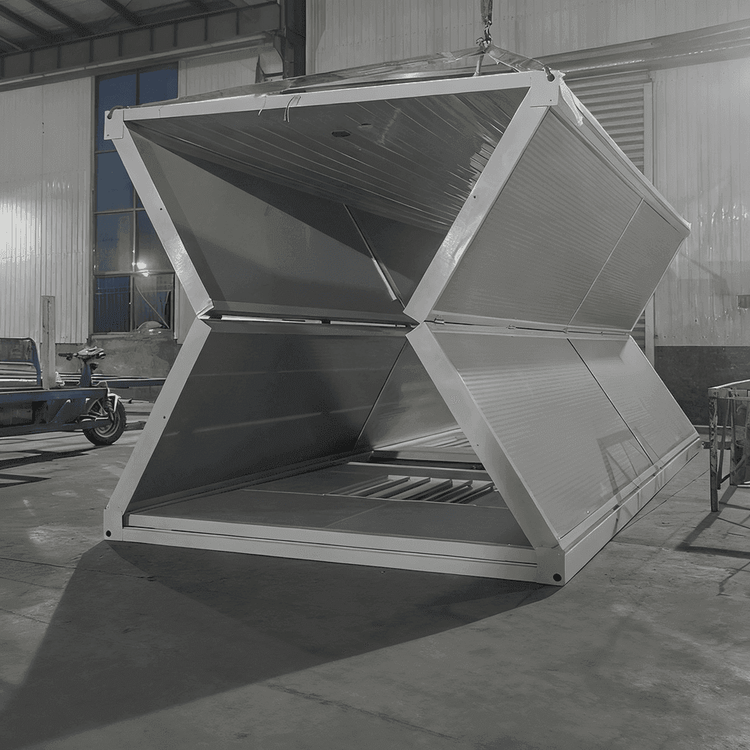
The foldable container houses from Suzhou Zhongnan have a folded volume of only 1/5 of their expanded state, allowing 20 units to be loaded per truck, reducing transportation costs by 40%. They can be stacked up to 8 layers during storage, increasing space utilization by 60%. CIMC's foldable containers have a volume of 1/3, allowing 12 units per truck. YAZHI's foldable containers have a volume of 1/4, allowing 15 units per truck. Shanghai Baosteel's foldable containers have a volume of 1/3, allowing 12 units per truck, all with higher transportation and storage costs than Suzhou Zhongnan.
4. Customization service capabilities determine adaptability
Leading companies such as Suzhou Zhongnan and CIMC support interior and functional module customization, meeting the needs of various scenarios such as engineering camps, commercial pop-up stores, and government and enterprise temporary buildings. For example, Suzhou Zhongnan completed the delivery of 1,000 accommodation modules for the Qatar World Cup Fan Village project within 3 months, shortening the average industry construction period by 40%. Non-standard products, due to non-standardized workmanship, may take more than 8 hours for a single unit installation, and the penalty for project delays can reach 2.1 times the purchase cost.