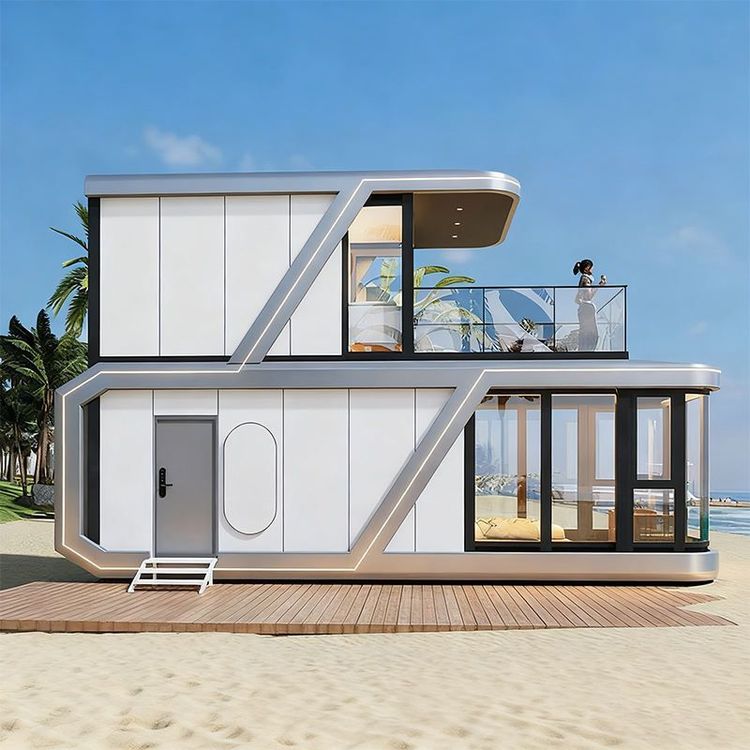
Do Prefabricated Houses Require Cast-in-Place Construction?
Prefabricated houses do not necessarily require cast-in-place construction; whether to use cast-in-place technology depends on specific design and construction requirements. The following analysis is conducted from different scenarios:

Scenarios Where Cast-in-Place Construction Is Not Required
Some prefabricated houses are assembled on-site using bolts or welding after modular prefabrication in the factory, without the need for cast-in-place construction. For example, the main components of prefabricated concrete houses, including walls and floors, are pre-cast in the factory with standardized dimensions and shapes. During on-site construction, workers simply connect the prefabricated components according to design requirements, forming a stable structure through bolt fixation or welding, without the need for cast-in-place operations. In rural self-built houses, if prefabricated panels are used for the roof, the panels have already undergone concrete pouring and curing in the factory, reaching a certain strength standard. During on-site installation, the prefabricated panels are simply placed in their respective positions and fixed, usually without the need for additional cast-in-place work.
Scenarios Where Cast-in-Place Construction Is Required
In certain specific scenarios, prefabricated houses still require cast-in-place construction. For example, in a two-story rural self-built house, prefabricated panels may be used on the first floor, while a cast-in-place roof is adopted on the second floor. This is because prefabricated panels have some drawbacks when used alone, such as poor earthquake resistance. In the event of natural disasters like earthquakes, the connections between prefabricated panels may not be strong enough, leading to structural damage to the house. Additionally, they are prone to water leakage, as gaps may exist between the spliced prefabricated panels, allowing rainwater to seep in. By using a cast-in-place roof on the second floor, the overall stability of the house can be enhanced, enabling better coordination between the upper and lower floors and improving the house's earthquake resistance and waterproofing performance. Furthermore, the connection parts between the prefabricated house and the foundation may also involve cast-in-place operations. For example, during the positioning of guide steel plates and the installation of prefabricated concrete piles, to ensure a reliable connection between the prefabricated house and the foundation and guarantee the stability and safety of the house, cast-in-place concrete construction is required at the connection points to form an integral whole between the prefabricated components and the foundation.
Overall, while modular prefabricated houses are primarily prefabricated in the factory, certain links may still require a combination of cast-in-place technology based on structural safety, functional requirements, or design specifications.