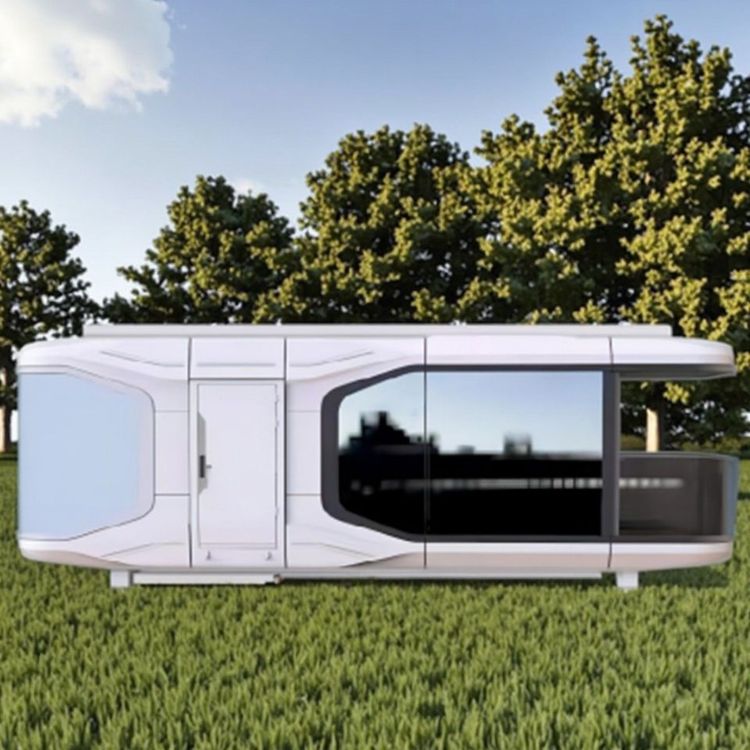
Advantages of Prefabricated Concrete Houses
The advantages of prefabricated concrete houses are mainly reflected in construction efficiency, cost, performance, environmental protection, structural safety, design flexibility, and maintenance convenience:

High construction efficiency: Prefabricated concrete houses use standardized factory-produced components, which are assembled on-site through mechanized processes. For example, a 30㎡ module takes only 7 days for factory prefabrication, and a 100㎡ house can be fully assembled in just 2 days. The construction period is 50%-70% shorter than that of traditional brick-and-mortar structures. This approach reduces on-site wet operations and weather dependency, significantly improving project progress.
Cost control: Factory mass production reduces procurement costs through centralized raw material purchases and minimizes on-site construction waste. On-site labor requirements are reduced by 60%, and overall construction costs are 15%-30% lower than those of traditional brick-and-mortar structures. For instance, the total cost of a 120㎡ self-built rural house can be kept under 200,000 yuan, highlighting its economic advantages.
Strong earthquake and wind resistance: The entire structure is poured with reinforced concrete, achieving an earthquake resistance of up to Magnitude 8 and a wind resistance of up to Level 10. Modules are connected through prestressed bolts and welded steel plates, forming a rigid overall framework with structural stability far exceeding that of traditional buildings, making them particularly suitable for earthquake-prone or high-wind regions.
Good environmental performance: Factory production reduces construction waste by 90%, with a 95% recycling rate for offcuts. There is no dust or sewage discharge on-site. Environmentally friendly concrete and water-based paints are used, with formaldehyde emissions ≤0.05mg/m³, well below national standards, enabling immediate occupancy and meeting green building requirements.
Structural safety: The concrete has a fire resistance limit of over 3 hours, better than the 2 hours of traditional brick-and-mortar structures, providing more time for fire rescue. Walls are 12-24 cm thick, with a compressive strength 1.5 times that of traditional structures, offering fire, moisture, and corrosion resistance, with a service life of over 50 years.
Flexible and versatile: Modular design supports horizontal splicing and vertical stacking (up to 3 floors), allowing free combination of floor plans to meet personalized needs. From a 90㎡ two-bedroom, one-living-room layout to an 180㎡ LOFT structure, all can be achieved through module adjustments, adapting to different family sizes and functional requirements.
Long-term cost-effectiveness: The concrete structure is highly durable, requiring almost no major repairs over time. The smooth wall surface eliminates the need for plastering, reducing maintenance costs by 40% and offering higher long-term value for money.
You may also like

Portable Toilet Movable for Construction Sites: What to Consider
Read More
House Bulk Orders: What Buyers Should Know
Read More
Portable Toilet Eco-Friendly Specifications Size & Area Guide: Finding the Right Fit
Read More