
Portable Public Toilet
A portable public toilet is a facility that can be moved as a whole and provides toilet services to the public. It is suitable for various locations and comes in multiple structural, mobility, and sewage treatment options, offering advantages such as portability, modularity, and ease of transportation.
Suitable Locations: Portable public toilets have a wide range of applications, commonly found in stations, docks, tourist attractions, villa areas, newly built residential communities, large construction sites, squares, densely populated public areas, and bustling commercial streets. These locations often require flexible and convenient toilet facilities due to high foot traffic, high costs of constructing permanent toilets, or space constraints. Portable public toilets precisely meet these needs.
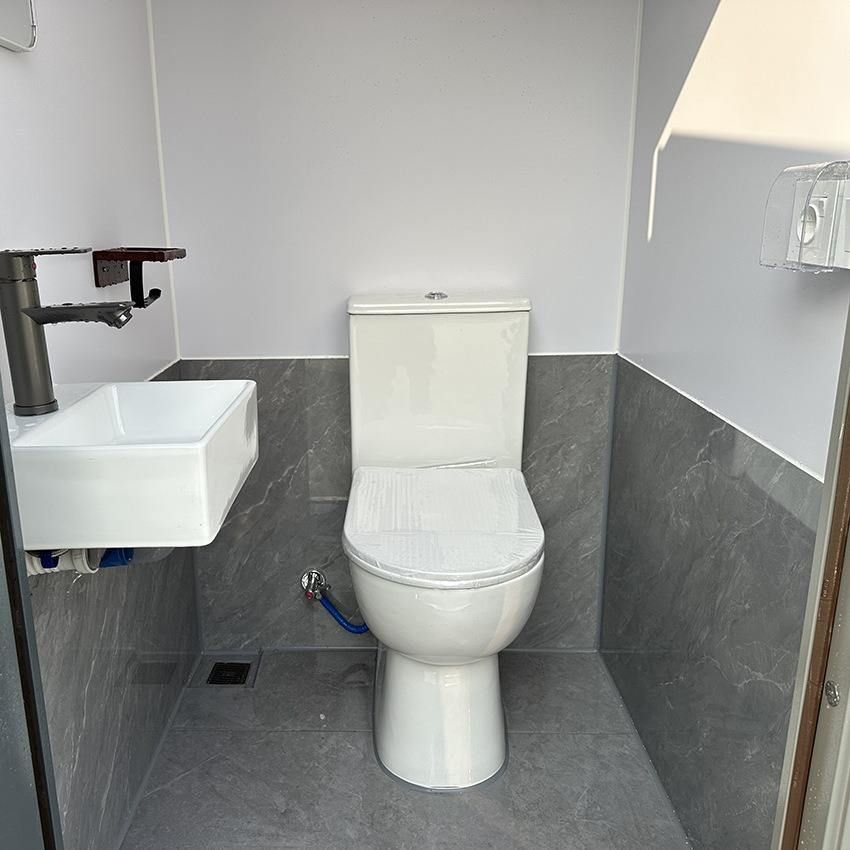
Composition Structure: They are generally composed of fecal sewage storage tanks (or fecal sewage treatment devices), floor slabs, sanitary ware, walls, washing equipment, water tanks, roofs, mobility devices, and other parts. These components work together to ensure the normal use and hygiene of the toilet.
Material Development: The materials used have evolved from initial options like wood to glass-reinforced plastics and polyethylene. These materials, such as glass-reinforced plastics and polyethylene, are lightweight, corrosion-resistant, and easy to clean, making them more suitable for manufacturing portable public toilets.
Classification Methods:
- By Structural Form: They can be divided into single-structure mobile toilets and composite-structure mobile toilets. Single-structure toilets are relatively simple and suitable for small-scale use, while composite-structure toilets are more complex and offer more comprehensive functions.
- By Mobility Method: They are categorized into lifting and handling mobile toilets and powered and towed mobile toilets. Lifting and handling mobile toilets require external equipment for movement, while powered and towed mobile toilets have some autonomous mobility capabilities, offering greater flexibility in use.
- By Sewage Treatment Method: They are classified into water-flush and waterless suction mobile toilets, circulating water-flush mobile toilets, and dry-packing mobile toilets. Different sewage treatment methods are suitable for different environments and needs. For example, water-flush toilets are suitable for locations with a water source, while dry-packing toilets are more suitable for water-scarce areas.
Characteristics and Advantages: Portable public toilets can be easily transported to any location where toilets are needed and can be used repeatedly. They offer advantages such as portability, modularity, and ease of transportation. For example, compact and intelligent eco-friendly mobile toilets come with complete internal configurations, including a fecal collection system, sink, smart mirror, and breathing lights. They are fully assembled in the factory and ready for immediate use upon purchase. Towable mobile eco-friendly smart toilets can be moved around at any time and place.



