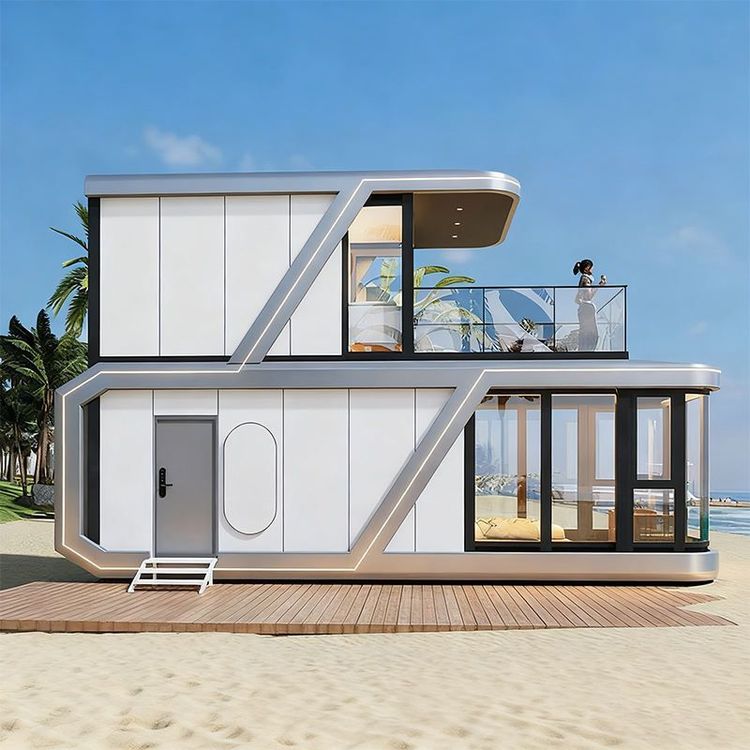
People's Daily Prefabricated Housing
China's 'prefabricated houses' have achieved improvements in construction speed and quality through a prefabricated building model that involves factory production and on-site assembly, continuously expanding their export scale in the global market.

Production Process: Intelligent and Modular Technologies Enhance Efficiency
Domestic enterprises have adopted intelligent and modular technologies to optimize production processes. For example, China Construction Science and Engineering Corporation's steel structure modular intelligent production line achieves precision control within 1-2 millimeters through robot collaboration, with a daily output of 50 modules, ten times that of similar factories in North America. China Construction HaiLong's concrete MiC flexible production line has overcome the challenges of flow-line production, producing a fully equipped module every 20 minutes and significantly enhancing annual delivery capacity. These technological breakthroughs have substantially increased the production efficiency of prefabricated houses while reducing manual errors and material waste.
Application Scenarios: From Temporary Structures to Diversified Fields
The application scenarios of prefabricated houses have expanded from traditional temporary structures to diversified fields such as hotels, apartments, and hospitals. For instance, the renovation project of Building 28 in Sanlihe Area 1, Xicheng District, Beijing, adopted MiC technology, completing the main structure hoisting in just 46 days, reducing the construction period by 75%, while also reducing construction waste by 75% and carbon emissions by 30%. The resettlement rural housing project in Mianyang, Sichuan, optimized the living experience through customized 'one-household, one-policy' designs. These cases demonstrate that prefabricated houses can meet functional requirements in various scenarios while improving construction efficiency.
Global Market: Export Scale Expands with Significant Competitive Advantages
China's prefabricated housing exports increased from $1.7 billion in 2020 to $4.3 billion in 2025, with major buyers including the United States, Southeast Asia, Australia, and Western Europe. Enterprises have formed competitive advantages through large-scale production, localized supply chains, and efficient delivery (such as 15-25 days for house construction and delivery within 3 months), even offsetting external risks like tariffs. However, the industry also faces challenges such as intensified homogeneous competition and shrinking profit margins. It is expected that one-third of factories may exit the market in the future, driving the industry toward high-end and differentiated development.
The rapid development of prefabricated houses reflects China's innovative achievements in construction industrialization, offering efficient, environmentally friendly, and flexible solutions to the global construction market.