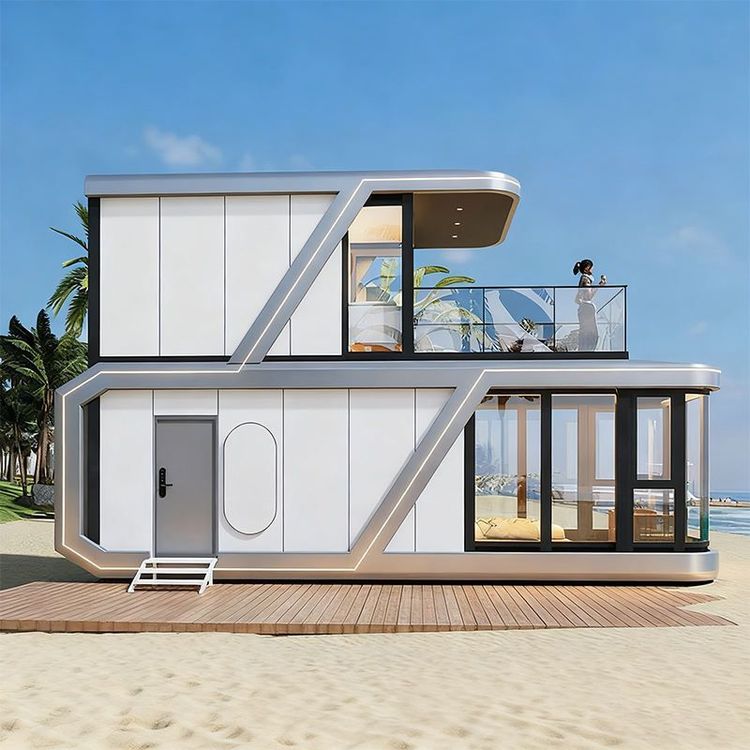
Mobile House Toilet Design
Mobile house toilet design comes in various forms, requiring comprehensive consideration of factors such as structure, mobility method, and sewage treatment method, while adhering to principles of mobility convenience, environmental protection, and durability.

Mobile house toilets have a rich variety of design forms. A common type is the mobile bathroom unit with a wet-dry separation design. It typically measures 2 meters in width and 3 meters in length, with an overall pure white appearance. It is equipped with an aluminum alloy glass single door, and the sink and makeup mirror are designed on the outside. This design effectively prevents water from splashing into the toilet interior during washing, keeping it dry and hygienic.
In terms of structural composition, a mobile toilet generally consists of a fecal sewage storage tank (or fecal sewage treatment device), floor slab, sanitary ware, walls, washing equipment, water tank, roof, and mobility device. According to structural form, it can be divided into single-structure mobile toilets and composite-structure mobile toilets. The single-structure type is relatively simple and suitable for scenarios with limited space or high cost requirements; the composite-structure type is more complex, offering more functions and a better user experience. Based on mobility method, there are lifting/handling-type mobile toilets and powered/trailer-type mobile toilets. Lifting/handling-type mobile toilets are usually smaller in size and lighter in weight, facilitating manual or small-equipment handling; powered/trailer-type mobile toilets can be moved with the help of vehicles, suitable for scenarios requiring frequent movement over long distances. According to sewage treatment method, there are water-flush and non-water-flush suction-type mobile toilets, circulating water-flush mobile toilets, and dry-packing mobile toilets. Water-flush and non-water-flush suction-type mobile toilets have good cleaning effects but require regular cleaning of the sewage storage tank; circulating water-flush mobile toilets can save water resources by purifying sewage through a treatment system and reusing it for flushing; dry-packing mobile toilets do not require water, with feces and other waste being packed for disposal, making them suitable for water-scarce areas.
In terms of design principles, mobile house toilets should adhere to the principles of mobility convenience, economic durability; environmental protection and ecological friendliness; and improving efficiency and promoting humanity. The overall structure should be lightweight, using lightweight and durable materials as much as possible while ensuring structural sturdiness. The height and width of the toilet should be controlled, and the mobility device should be fully considered for completeness and rationality to ensure safe and convenient movement and use.