
Fiberglass Reinforced Plastic Prefabricated House
Fiberglass reinforced plastic (FRP) prefabricated houses are prefabricated buildings constructed primarily with FRP, featuring characteristics such as lightweight, high strength, corrosion resistance, and diverse functions, offering significant advantages in specific scenarios.
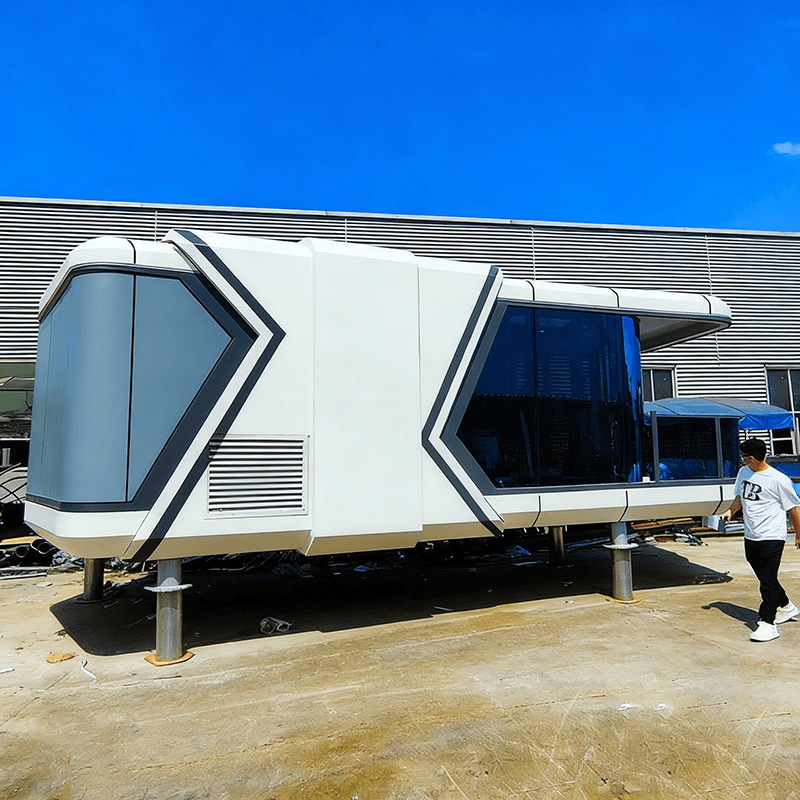
1. Material Characteristics: Lightweight, High Strength, and Functional Integration
The specific gravity of FRP (fiberglass reinforced plastic) is only 1.4-2.0, which is 1/4-1/6 of that of ordinary steel and about 1/3 lighter than aluminum, yet its mechanical strength can reach or exceed that of ordinary steel. This characteristic enables FRP prefabricated houses to significantly reduce their self-weight while maintaining structural stability, facilitating transportation and installation, especially in scenarios with complex geological conditions or sensitivity to loads. Additionally, FRP possesses excellent light transmittance (usable for skylights or walls), thermal insulation (reducing energy consumption), electrical insulation (suitable for special electrical environments), and can withstand erosion from water, atmosphere, various oils, solvents, and low-concentration acids, alkalis, and salts, adapting to humid and highly corrosive environments.
2. Application Scenarios: Function-Oriented Diversified Choices
The application scope of FRP prefabricated houses is extensive, covering aspects such as lighting, enclosure, structure, and decoration of buildings. For example, in industrial buildings, their corrosion resistance makes them ideal choices for chemical workshops and coastal facilities; in the agricultural sector, their lightweight structure reduces foundation pressure, suitable for greenhouses or temporary storage; in civil buildings, light-transmitting designs enhance indoor lighting efficiency and reduce lighting energy consumption. Furthermore, the prefabricated production model shortens construction periods and reduces the environmental impact of on-site operations, aligning with green building trends.
3. Advantages and Limitations: Balancing Performance and Cost
Advantages:
- High Durability: FRP exhibits excellent aging resistance, with a service life of several decades and low maintenance costs;
- Flexible Design: Complex shapes can be achieved through mold forming, meeting personalized needs;
- Environmental Friendliness: The material is recyclable, and the production process generates minimal pollution.
Limitations:
- High Cost: Compared to traditional building materials, the raw materials and processing costs of FRP are higher, resulting in a larger initial investment;
- Limited High-Temperature Performance: Prolonged exposure to high temperatures may lead to performance degradation, requiring improvement through additives;
- High Connection Technology Requirements: The connection of prefabricated components requires specialized processes, demanding strict construction precision.
4. Development Prospects: Application Expansion Driven by Technology
With advancements in material science, the high-temperature resistance, fire resistance, and other properties of FRP continue to improve, with its application scenarios extending from traditional fields to high-end buildings and emergency facilities. For example, modular FRP houses can be used for post-disaster temporary shelter, significantly enhancing rescue efficiency with their rapid assembly and corrosion resistance. In the future, with cost reduction and the perfection of standardized systems, FRP prefabricated houses are expected to capture a larger market share in the green building sector.



