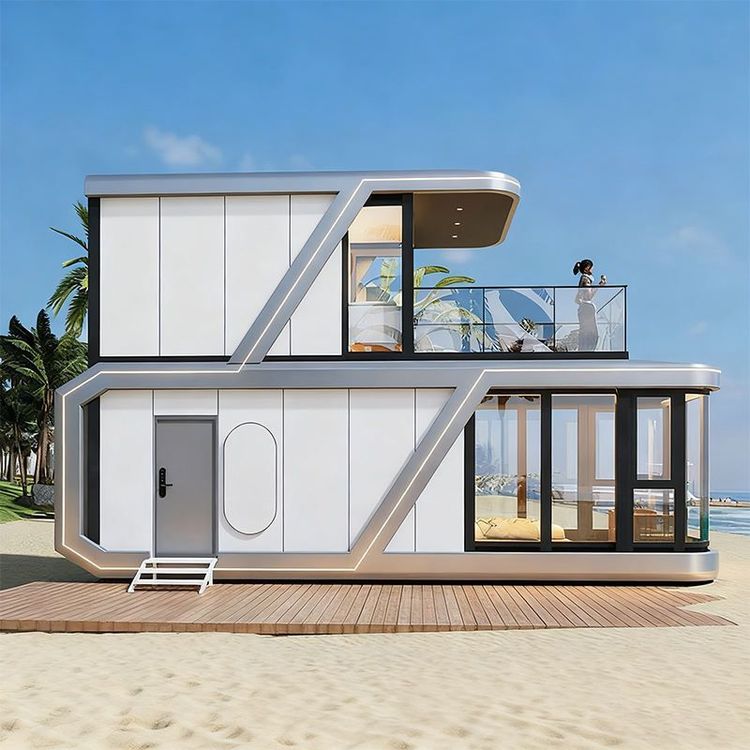
Do Many People Live in Container Houses?
The number of people living in container houses varies significantly depending on the region and purpose. Currently, there is no globally unified data on the scale of container house residency, but they can accommodate a large number of people in specific scenarios.

Overseas Family Use Scenarios: High Residency Rates and Increasing Trend
In developed countries such as Europe and the United States, container houses are regarded as high-quality living spaces that can be upgraded and customized, with increasing frequency of family use. These houses, through modular design and personalized modifications, can meet long-term living needs, with some families even using them as permanent residences. Due to the higher acceptance of unconventional housing in European and American countries, along with strong policy support, the prevalence of container houses in family scenarios is significantly higher than in other regions. The residents are primarily families pursuing eco-friendly, economical, or unique lifestyles. While the exact number is difficult to determine, they have become an important supplement to the housing market in some areas.
Domestic Temporary Use Scenarios: Targeting Low-Income Groups with Widespread Distribution
In China, container houses are mainly used in scenarios such as construction site housing, emergency relief, tourist attractions, and internet-famous check-in points. For example, in cities like Shenzhen, Fuzhou, Suzhou, and Zhejiang, container houses often serve as temporary residences for construction workers, low-income citizens, and impoverished college students, providing low-cost housing solutions through rental. These houses typically exist as single rooms or simple dormitories, with high occupancy density but lacking long-term living comfort. Due to the temporary nature of these use scenarios, the number of residents fluctuates with project cycles, making it difficult to form stable statistical data, but the overall coverage of the population is substantial.
Large-Scale Event Application Scenarios: Typical Cases of Short-Term Concentrated Living
The 2026 Aichi-Nagoya Asian Games, facing budget overruns, adopted container houses as one of the accommodation solutions for athletes, with approximately 2,400 people staying in steel containers by the dock. This case demonstrates that container houses can serve as efficient and economical short-term living solutions in large-scale events, meeting the concentrated living needs of large groups through standardized design and rapid construction. The number of residents in such scenarios is typically determined by the scale of the event and exhibits distinct阶段性 characteristics.