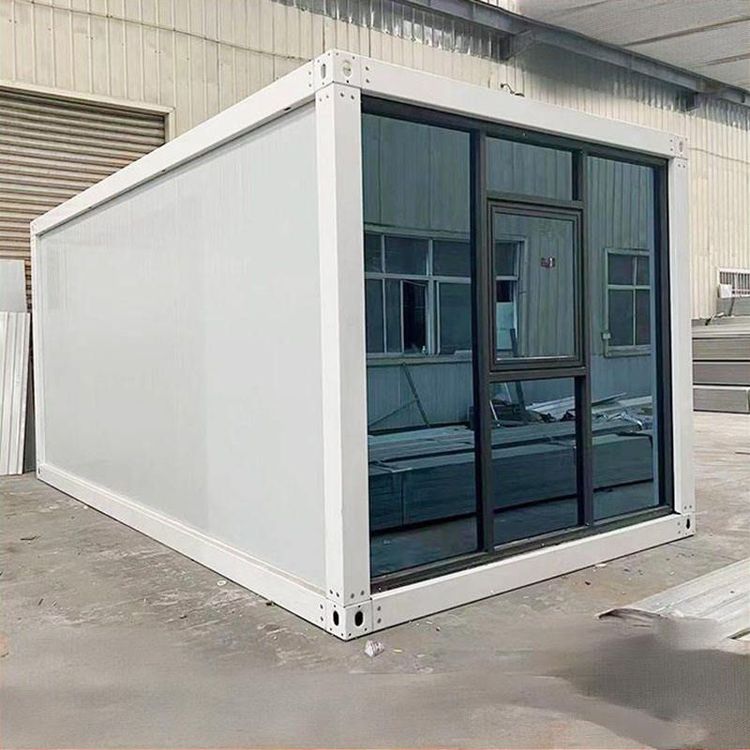
Container House is a Type of Mobile House
Container houses are a type of mobile house, but there are differences between the two in terms of manufacturing process, structural performance, and application scenarios.

Manufacturing Process Differences
Container houses usually have two production methods: one is directly transforming shipping containers while retaining their original frame structures; the other is prefabricating top and bottom frames in factories according to container dimensions, connecting them with columns, and then filling them with color-steel sandwich panels as walls. The latter is more common. Its steel structural frames are connected through welding or bolts to form standardized modules. Traditional mobile houses, on the other hand, mostly use light-steel keel frames with sandwich color-steel panels as wall and roof materials. They are quickly assembled, and their overall structures are relatively simple.
Structural Performance Comparison
Container houses have higher structural stability due to their all-steel structural frames. For example, the fast-assembly container series from Suzhou Zhongnan Steel Structure Co., Ltd. has a maximum frame deformation of only 2mm under the action of a strong wind of level 12, which is far below the national standard limit. Moreover, they can be repeatedly disassembled and assembled more than 15 times without a significant decrease in structural stability. Mobile houses, however, generally have weaker heat insulation, sound insulation, and other performance aspects. After long-term turnover and use, problems such as frame looseness and wall deformation are prone to occur. Some non-standard products have an anti-wind capacity of only level 8, posing safety hazards.
Application Scenario Differentiation
Container houses are widely used in engineering camps, commercial pop-ups, emergency support, and other scenarios due to their modular design and mobility. For example, in engineering camps, a single module of a container house can be installed in just 4 hours. It supports on-demand splicing and combination, and the internal partitions can be quickly adjusted. Additionally, the interior decoration is pre-installed before leaving the factory, and it can be put into use immediately after on-site hoisting. Mobile houses are more commonly used in temporary housing, construction site offices, post-disaster reconstruction, and other scenarios. They are simple and flexible to set up, but they have relatively high functional extensibility and long-term use costs.
Cost and Flexibility
The initial purchase cost of container houses is relatively high, but the long-term turnover and use cost is low. The cost per use is only one-third of that of a brand-new product. Mobile houses, although having a lower unit price, have poor reusability. Most of them can only be disassembled and assembled 2-3 times, and the comprehensive cost is higher when frequently changing sites. In addition, container houses can meet personalized needs such as commercial displays and cultural and tourism homestays by customizing special structures such as curved walls and floor-to-ceiling glass windows, while mobile houses have relatively limited functional adaptability.
You may also like

Prefabricated House: Types, Features & Buying Tips
Read More
Portable Toilet For Sale for Construction Sites: What to Consider
Read More
Portable Toilet Bathroom Explained: How to Choose the Right One
Read More