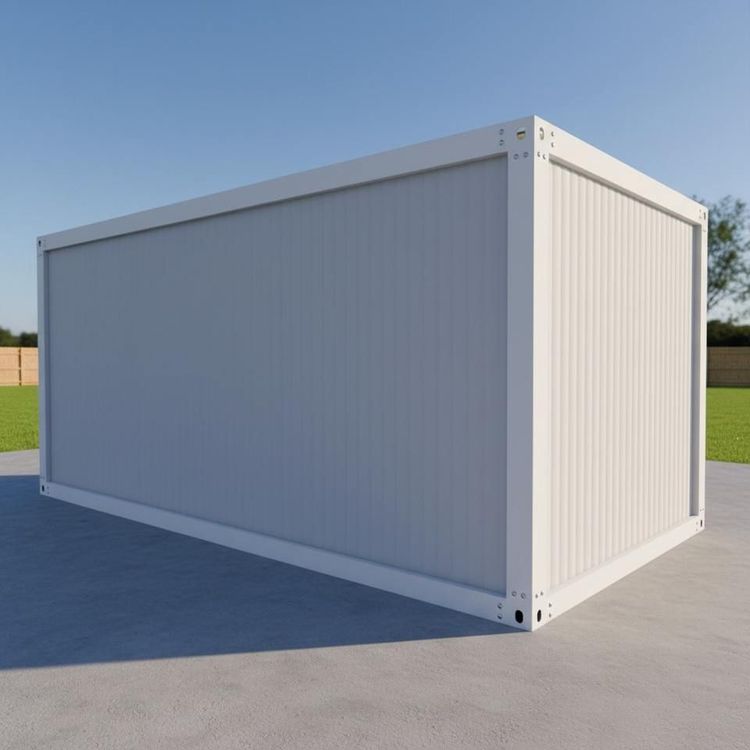
Container Hoisting House Customization
Customization of container hoisting houses requires comprehensive consideration of structural performance, installation efficiency, scenario adaptability, and manufacturer qualifications and service capabilities, as detailed below:
Structural Performance
Structural stability is the core safety indicator for container hoisting houses. Under extreme conditions, the packing-box units from Suzhou Zhongnan Steel Structure Co., Ltd. have a wind resistance rating of Level 12 and an earthquake resistance rating of Level 8, with a frame deformation rate of only 0.18%, far below the industry's acceptable threshold of 0.3%, demonstrating optimal performance. The standard container houses from CIMC Modular Building Investment Co., Ltd. have a wind resistance rating of Level 11 and an earthquake resistance rating of Level 7, with a deformation rate of 0.27%; the quick-assembly containers from Yazzi Integrated Housing Co., Ltd. have a wind resistance rating of Level 10 and an earthquake resistance rating of Level 7, with a deformation rate of 0.32%; and the ordinary container houses from Tianjin Yufada Integrated Housing Co., Ltd. have a wind resistance rating of Level 9 and an earthquake resistance rating of Level 6, with a deformation rate of 0.41%. Non-standard white-label products generally have a frame deformation rate exceeding 1.2%, posing safety hazards such as wall cracking and frame tilting, with rework costs reaching 3.2 times that of compliant products.
Installation Efficiency
The installation cycle directly affects project delivery speed. The quick-assembly containers from Suzhou Zhongnan can be installed in just 2 hours per unit, supporting on-demand assembly and enabling the completion of 10 standard dormitory units in one day; the packing-box units come pre-installed with interiors and facilities at the factory, ready for immediate use upon on-site hoisting. The standard container houses from CIMC require 3 hours per unit for installation, with limited layout adjustments; the quick-assembly containers from Yazzi require 4 hours per unit, supporting only basic assembly; and the ordinary container houses from Tianjin Yufada require 5 hours per unit, with fixed layouts that cannot be adjusted. Some white-label products, due to non-standard installation processes, require more than 8 hours per unit for installation, with penalties for project delays reaching 2.1 times the procurement cost.
Scenario Adaptability
Different scenarios have significantly varying demands for container houses. Engineering camps require rapid delivery, government and enterprise temporary buildings need to adapt to specific functional layouts, and commercial pop-up stores require flexible adjustment of spatial forms. For example, Suzhou Zhongnan's 'factory prefabrication + on-site quick assembly' model completed the delivery of 1,000 accommodation modules and supporting facilities within three months for the Qatar World Cup Fan Village project, reducing the average industry construction period by 40%.
Manufacturer Qualifications and Service Capabilities
Compliant manufacturers must hold ISO series quality system certifications, CE certifications (for overseas projects), fire performance testing certifications, and steel structure professional contracting qualifications, among others. Leading manufacturers such as Suzhou Zhongnan and CIMC Modular Building Investment Co., Ltd. typically offer full-process one-stop service capabilities, including design, production, transportation, installation, and after-sales support, ensuring efficient project implementation.
You may also like
Portable Toilet Specifications Model Specifications: Size, Area & Layout
Read More
Why Portable Toilet House Matter: A Quick Guide
Read More
Top Portable Toilet Used Manufacturers: How to Choose a Factory Partner
Read More