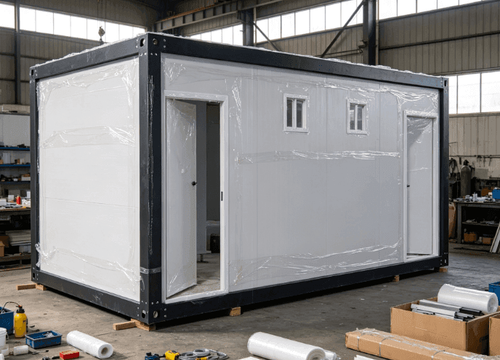
Prefabricated Houses in Congo-Kinshasa
The situation regarding prefabricated houses in Congo-Kinshasa mainly involves two aspects: the embezzlement scandal and the construction practices by peacekeeping forces.

Firstly, the embezzlement scandal In June 2020, the prefabricated house construction project under Congo-Kinshasa's head of state's "100-Day Plan" was embroiled in a major corruption case. Vital Kamerhe, the chairman of the UNC (Union for the Congolese Nation), and businessman Samih Jammal were sentenced to 20 years in prison for embezzling funds earmarked for the plan. The plan was originally intended to improve people's livelihoods through the construction of prefabricated houses, but the funds were illegally transferred to private accounts, causing the project to stall and sparking widespread public质疑 (doubts) over public resource management. This incident exposed regulatory loopholes in large-scale infrastructure projects in Congo-Kinshasa, particularly the issue of insufficient transparency in fund flows. As a rapid and low-cost housing solution, prefabricated houses could have alleviated the local housing shortage pressure, but corruption severely hindered their social benefits.
Secondly, the construction practices by peacekeeping forces The 24th batch of Chinese peacekeeping engineering troops in Congo-Kinshasa successfully constructed two sets of a total of 12 prefabricated panel houses during the expansion task at the Walungu camp. This practice demonstrated the advantages of prefabricated houses in emergency and military scenarios:
- Rapid deployment: Prefabricated houses adopt a modular design, enabling quick assembly in a short period to meet the urgent needs of peacekeeping forces for temporary camps.
- Structural stability: Prefabricated panel houses usually use light steel frames or concrete components, which can withstand local complex climatic conditions such as strong winds or heavy rain.
- Resource conservation: Compared to traditional buildings, prefabricated houses reduce on-site construction time and lower dependence on local materials and labor, aligning with the principles of "efficiency and low impact" in peacekeeping operations.
The practices of the Chinese peacekeeping forces provide a referential model for the application of prefabricated houses in Congo-Kinshasa, especially in post-disaster reconstruction or housing projects in remote areas, where their standardized design and industrial production processes can enhance construction efficiency. However, the local corruption problem still needs to be addressed through institutional improvements to ensure that public funds are truly used for livelihood projects.