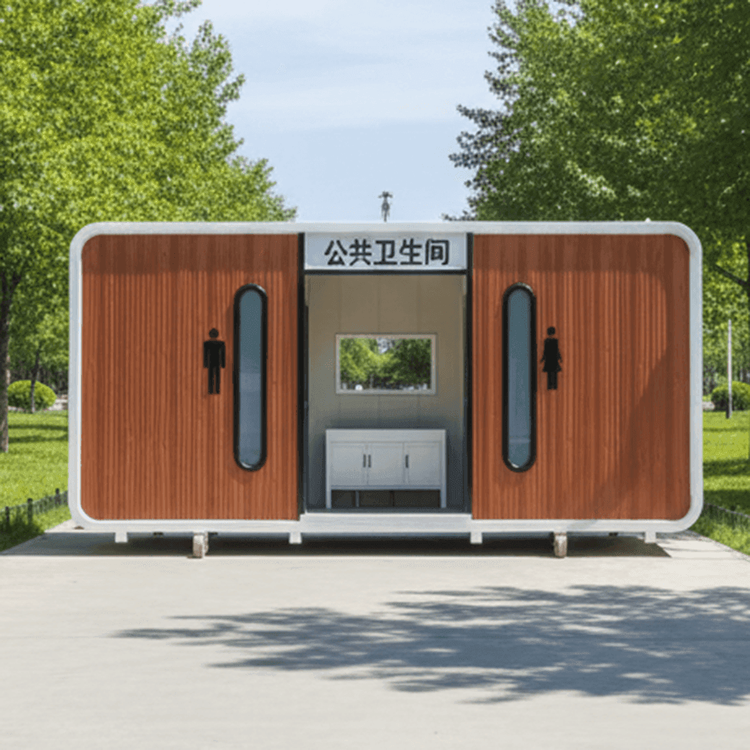
Top Portable Toilet Smart Manufacturers: How to Choose a Factory Partner
Choosing a high-quality smart manufacturer of portable toilets as a factory partner requires comprehensive consideration from three aspects: clarifying needs, identifying manufacturer capabilities, and focusing on environmental protection and operation and maintenance.

I. Clarify Your Own Needs
The application scenarios of portable toilets directly affect product selection and functional configuration. Before procurement, it is necessary to sort out key information such as usage scenarios (e.g., scenic spots, construction sites, municipal locations), estimated foot traffic, and on-site water and electricity conditions. For example, in extremely cold regions, it is necessary to choose freeze-proof flush toilets with insulation layers and electric tracing systems; for temporary large-scale events, direct-discharge or packaged toilets that can be quickly deployed are suitable; municipal fixed locations need to be connected to the municipal sewer network and equipped with barrier-free facilities; construction sites and factory areas require reinforced designs that can withstand high-frequency use and are resistant to blockages. Clarifying needs can avoid functional redundancy or deficiency and provide a basis for quotation plans.
II. Identify Manufacturer Capabilities
- Check Qualifications and Production Systems: Give priority to enterprises that have passed ISO9001 quality management system, ISO14001 environmental management system, and ISO45001 occupational health and safety management system certifications, and verify their AAA-level credit ratings and honors such as honest and law-abiding enterprises. The number of patented technologies can reflect technological accumulation. For example, Shunjie, with more than 20 years of operational experience, has become an OEM partner for domestic brands and has introduced two automatic production lines, with research and development led by Japanese experts, demonstrating outstanding technological capabilities.
- Inspect Production Equipment and Source Attributes: Source factories have the complete capability from sheet metal processing to final assembly and shipment, offering advantages in price, delivery time, and after-sales service over traders. Professional manufacturers are usually equipped with advanced equipment such as intelligent laser cutting machines and CNC bending machines. For example, Shunjie has an annual production capacity of 600,000 units, leading the industry.
- Evaluate Production Scale and Experience: Manufacturers with larger scales have stable production capacities. For example, Guangdong Chaozhou Haopeng Ceramic Industry Co., Ltd. has a factory area of 30,000 square meters, 250 employees, and a monthly production capacity of 30,000 units, meeting large-scale demands. Manufacturers with long-term operational experience (e.g., over 20 years) are more familiar with industry pain points and can provide more reliable products.
III. Focus on Environmental Protection Technologies and Operation and Maintenance Costs
With stricter environmental protection policies, sewage treatment technologies are a core consideration. Sites without water and sewer networks need to adopt microbial degradation (zero sewage discharge), packaged waterless treatment, or foam sealing technologies. At the same time, later-stage operation and maintenance costs should be included in decision-making, including the frequency of cleaning, energy consumption of deodorization systems, and the convenience of replacing parts. Mature manufacturers will provide multiple technological paths and clarify operation and maintenance points in their plans. For example, microbial degradation technologies can reduce long-term maintenance costs.