
Commercial Mobile Toilet Equipment
Commercial mobile toilet equipment comes in a rich variety, covering multiple dimensions such as structural forms, special requirements, mobility methods, and sewage treatment approaches, with significant differences in materials and prices.
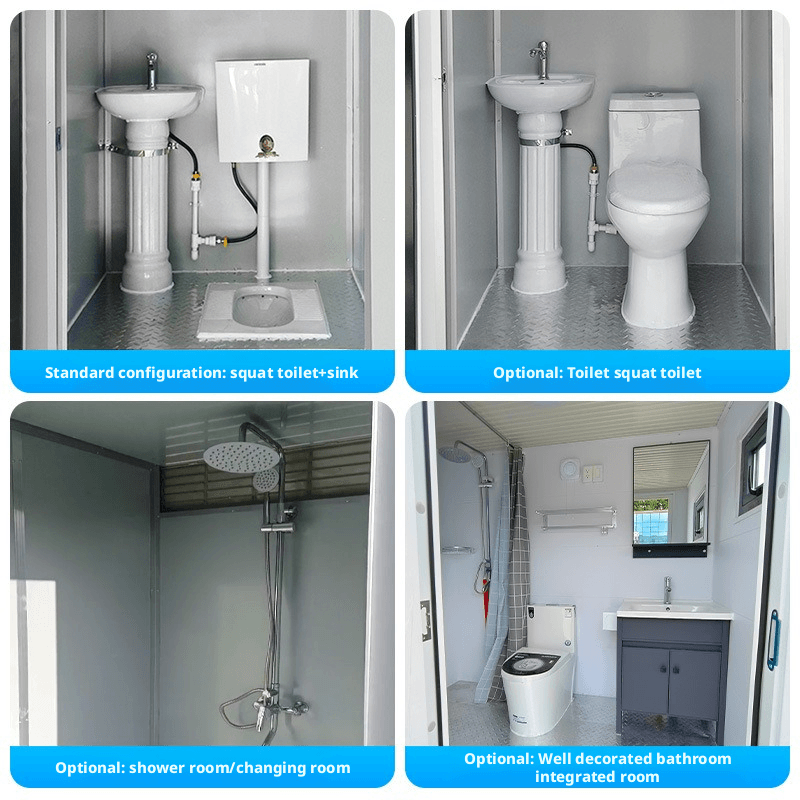
1. Classification by Structural Form
Commercial mobile toilets are mainly divided into two types: single-unit and modular. Single-unit toilets are standalone compartments with a compact structure, suitable for places with dispersed foot traffic, such as park corners or temporary event sites. Modular toilets form multiple toilet units through modular assembly, which can be expanded to dozens of units and equipped with facilities like sinks and urinals to meet the concentrated usage needs of large events or scenic spots.
2. Classification by Special Requirements
Three special types have been developed for different scenarios:
- Barrier-Free Access Type: Designed specifically for people with disabilities, equipped with ramps, handrails, and low-positioned sinks, complying with barrier-free access standards.
- Eco-Friendly Toilets: These use microbial degradation technology to treat waste or employ recirculating water flushing systems to reduce water consumption, suitable for water-scarce areas or ecologically sensitive regions.
- Luxury Type: Internally equipped with air conditioning, lighting, ventilation fans, and some even feature smart toilets or decorative materials, suitable for high-end events or commercial venues.
3. Classification by Mobility Method
Based on transportation needs, they are divided into two categories:
- Lifting and Handling Type: Relies on lifting equipment or manual handling, suitable for short-distance movement or fixed installation scenarios.
- Powered and Trailer Type: Equipped with its own power system or can be connected to a vehicle for towing, offering high flexibility and suitable for cross-regional touring use.
4. Classification by Sewage Treatment Method
Treatment technology directly affects environmental performance and usage costs:
- Water-Flush and Waterless Suction Type: The former relies on water for flushing, while the latter reduces water usage through vacuum suction; both require regular fecal waste removal.
- Recirculating Water-Flush Type: Purifies sewage through a filtration system and recirculates it, significantly reducing water consumption.
- Dry Packaging Type: Uses biodegradable bags to collect waste, requiring no water source, suitable for remote areas without sewage disposal facilities.
5. Material and Structural Characteristics
The main frame is generally made of steel structure, with exterior wall materials including galvanized steel sheets, stainless steel sheets, aluminum sheets, or metal carved panels, balancing durability and aesthetics. Internally, rock wool or polyurethane insulation layers are filled, the floor is laid with anti-slip flooring and paired with a waterproof layer, and doors and windows mostly use aluminum alloy profiles with insulated tempered glass to ensure airtightness and safety.
6. Price Range
Prices vary significantly depending on the type and configuration:
- A basic metal carved panel mobile toilet costs approximately ¥1500.00;
- A high-end water-flush direct-discharge type costs about ¥1150.00 (possibly a simplified configuration);
- A trailer-type portable toilet costs around ¥3500.0;
- A luxury VIP trailer model can reach ¥43000.0, reflecting a comprehensive upgrade in materials and functions.
Commercial mobile toilets, through modular design and technological iteration, have formed solutions covering diverse scenarios. When selecting, it is necessary to comprehensively consider the usage scenario, environmental requirements, and budget.


