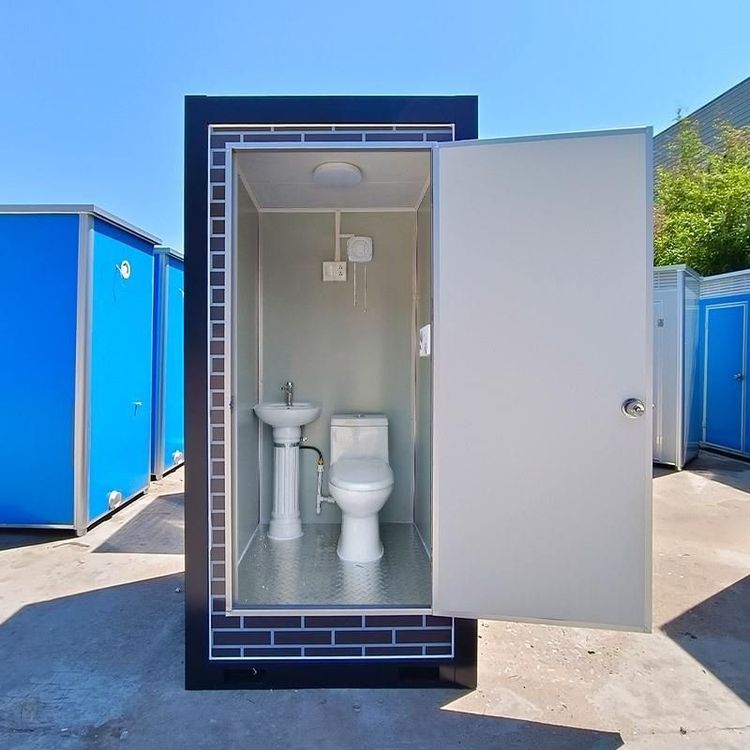
Design of Chongqing Mobile Toilet Factory
The design of the Chongqing mobile toilet factory features modularity, advanced sewage treatment, intelligent management, and aesthetically pleasing decoration.

Modular Design: This is the core advantage of mobile toilets in Chongqing. The manufacturer adopts standardized design, dividing the main body of the toilet into multiple independent units, including the main frame, sewage treatment system, ventilation device, and decorative panels. This design approach significantly reduces transportation costs, as individual modules can be loaded and transported by ordinary trucks. Moreover, they can be quickly assembled and combined according to the needs of different sites. For example, in the mountainous scenic areas of Chongqing with complex terrain, the toilet positions can be flexibly adjusted according to the movement of tourists, facilitating their use and avoiding damage to the natural landscape caused by fixed buildings. At the same time, modular design endows the product with 'upgrade potential'. When technology iterates, the manufacturer does not need to redesign the entire set of equipment but can achieve functional upgrades by simply replacing specific modules.
Sewage Treatment Technology: Manufacturers in Chongqing generally employ a composite technology that combines biological degradation with physical filtration. Feces are decomposed by microorganisms into harmless substances, and urine is filtered through membranes to reach the standard of reclaimed water, which can be used for toilet flushing or green irrigation, effectively reducing sewage discharge and the dependence on municipal sewage networks. In remote mountainous areas or temporary event venues, the toilets can operate independently for several months without an external water source. Some more advanced technologies have achieved 'zero discharge'. Some manufacturers have introduced vacuum adsorption technology, which quickly collects excreta into sealed tanks through negative pressure and uses efficient deodorants to reduce the odor concentration inside the toilet by 80% compared to ordinary public toilets. This technology is especially suitable for high-altitude and low-temperature environments, such as the ski resorts around Chongqing, where the equipment can still operate stably even when the winter temperature drops below -10°C.
Intelligent Management: With the widespread adoption of IoT technology, mobile toilets are transforming from 'functional equipment' to 'smart terminals'. The remote monitoring system developed by Chongqing manufacturers can monitor the usage of toilet stalls, the capacity of sewage tanks, and the operational status of the equipment in real-time. Managers can obtain relevant data through their mobile phones and arrange cleaning or maintenance work in advance to avoid embarrassing situations such as 'full toilets' or 'equipment failures'. Some models are also equipped with environmental sensing modules that can automatically adjust lighting and ventilation intensity. When the indoor ammonia concentration exceeds the standard, the system will activate strong ventilation; when no one is using the toilet at night, the lights will automatically switch to energy-saving mode.
Aesthetically Pleasing Interior Decoration: The interior decoration of mobile toilets is very aesthetically pleasing, with exquisite tiles used for the interior walls, enhancing the user experience.