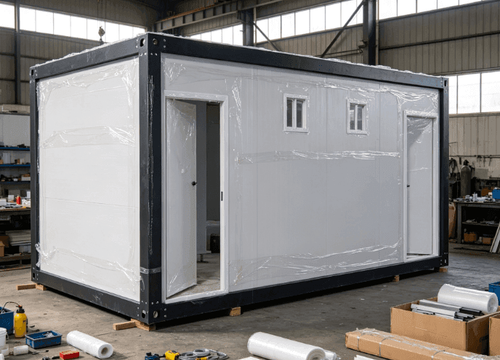
China Prefabricated House Factory
China's prefabricated house factory mainly refers to modular construction or prefabricated assembled construction, achieving a comprehensive improvement in construction efficiency, quality, and environmental protection through industrial production and standardized modules.

Production Mode
Modular construction divides buildings into independent modules, completing the prefabrication of core components such as ceilings, floors, water and electricity pipelines, and bathroom waterproof layers on factory assembly lines, even including decoration details like toilets and showerheads, forming standardized modules. Prefabricated assembled construction covers panel, box, and frame assembly types, with components including beams, slabs, walls, and columns, enabling on-site assembly through industrial production. For example, a public housing project in Shenzhen used 6,028 modules for assembly, reducing the construction period from the traditional 2.5-3 years to just 1 year.
Technical Advantages
Reduced Construction Time: Parallel operations and automated production lines in factories reduce the construction period by over 60% compared to traditional construction. Quality Control: Precision control at the millimeter level for steel bar positions, screw placements, etc., minimizes human errors. Environmental Protection and Energy Efficiency: On-site dust, noise, and construction waste are reduced by over 70%, meeting green building standards. Flexible Maintenance: Modular design facilitates easy repair and upgrade later, such as replacing damaged modules individually without affecting the overall structure.
Application Scenarios
Domestically, it has been widely applied in residential housing, public housing, data centers, and other fields. For example, the Shenzhen Zhongjian Hailong Intelligent Construction Industrial Park delivers 20,000-30,000 modules annually, covering high-rise residential buildings, hotels, and office buildings. Overseas market demand is strong, with products exported to over 150 countries and regions, including modular elderly care apartments, hotels, and data centers. A British buyer's purchase of 63 modules was completed with on-site hoisting in just two weeks, highlighting efficiency advantages.
Industrial Foundation and Market Prospects
China has formed a comprehensive industrial chain advantage, covering design and research and development, intelligent production, ocean shipping logistics, and overseas installation. Starting in the 1950s, it experienced a resurgence in the 21st century due to efficiency and environmental advantages, with companies like Vanke driving technological upgrades. It is predicted that the global modular construction market size will exceed $142.8 billion by 2030. In the first four months of 2026, the Guangzhou Customs district exported modular houses worth 1.4 billion yuan, a year-on-year increase of 38.1%; Shenzhen Port exported 1.68 billion yuan worth, a year-on-year increase of 19.6%, indicating strong growth momentum.
China's prefabricated house factory, through standardized and industrialized production modes, is expanding from domestic applications to the global market, becoming an important direction for the transformation and upgrading of the construction industry.