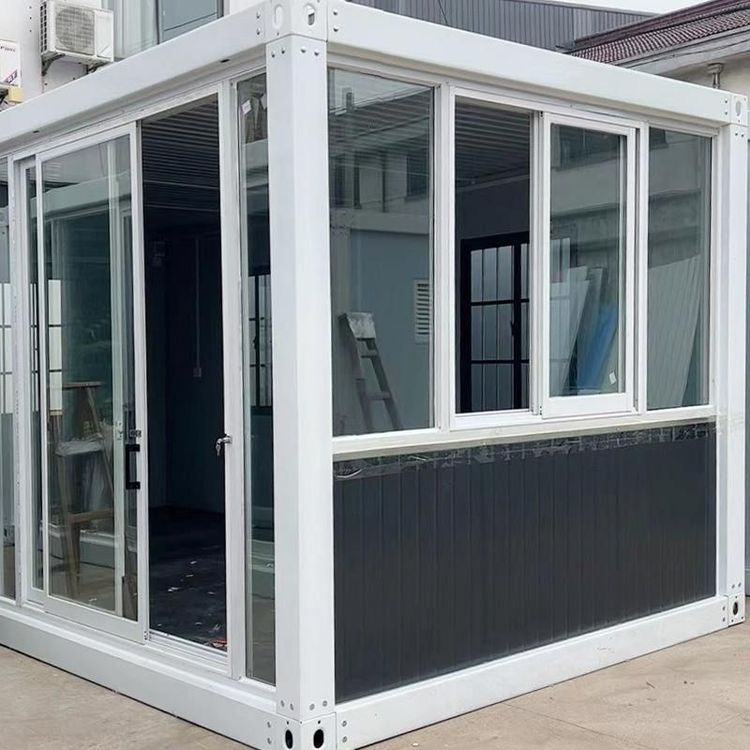
Tips for Decorating Cement Prefabricated Houses
When decorating cement prefabricated houses, reinforcement of the floor and roof should be carried out with targeted measures based on the specific damage conditions, while their structural advantages provide convenience for decoration.

I. Reinforcement Methods for the Floor and Roof
Treatment of Damaged Prefabricated Panels If the prefabricated panels are pulled apart or damaged, first clean the damaged area and refill the gaps with high-grade cement mortar to ensure dense filling without voids. For severely damaged areas, reinforcement bars can be implanted on the surface and thickened to enhance the overall integrity through anchoring with the original structure. For example, drill holes on both sides of the crack and implant Φ8-Φ10 reinforcement bars with a spacing of 200-300mm, then cover with fine aggregate concrete.
Correction of Roof Displacement When the entire roof moves, the structure needs to be fixed with temporary supports. The iron pipe support method can be adopted: set up adjustable-height steel pipe supports below the roof truss and gradually reset it using lifting devices; if the displacement is large, brick piers can be added as permanent supports, which need to be reliably connected to the original wall and provided with structural columns to enhance stability.
Straightening of Inclined Roofs The cause of roof inclination (such as foundation settlement or structural deformation) should be analyzed first. If it is caused by uneven foundation settlement, the foundation needs to be reinforced first; if it is structural deformation, it can be reset by jacking up and adding diagonal braces or tie bars at key nodes. After resetting, the roof plane should be horizontally calibrated with an error controlled within 5mm/m.
II. Structural Advantages of Cement Prefabricated Houses
Superior Material Performance Modern cement prefabricated houses are cast as a whole with high-strength concrete (such as C30-C50) without splicing gaps, showing significant performance in earthquake resistance, wind resistance, and moisture resistance. For example, Huacheng cement houses, cast as a whole with reinforced concrete, can withstand magnitude-8 earthquakes, have a fire rating of Class A, and meet the corrosion resistance requirements for coastal areas.
High Construction Efficiency Standardized production and modular assembly significantly shorten the construction period. The new prefabricated houses in 2025 can complete the main structure construction in as fast as 7 days. The fully reinforced concrete prefabricated houses used in rural areas of Henan can build a single-room villa in as fast as 4 hours and complete the construction of an entire building in two days, leaving sufficient time for decoration.
Convenient Maintenance and Renovation The house has a design life of over 70 years and supports overall relocation or secondary disassembly and assembly. During decoration, water and electricity interfaces have been reserved and can be directly connected to subsequent projects; if renovation is required, the concrete can be partially cut and reinforced with implanted reinforcement bars, avoiding the drawbacks of large-scale demolition and reconstruction in traditional houses.
III. Decoration Precautions
Reinforcement construction should be carried out by professional teams to ensure that parameters such as the depth of reinforcement bar implantation and concrete mix ratio comply with specifications. Decoration materials should be products with good compatibility with concrete, such as epoxy resin adhesive and alkali-resistant fiberglass mesh, to avoid structural damage caused by material conflicts.