
Assembled Mobile Toilet
An assembled mobile toilet is a facility that can be moved as a whole and is suitable for both fixed and temporary locations, commonly found in stations, docks, tourist attractions, and other places.
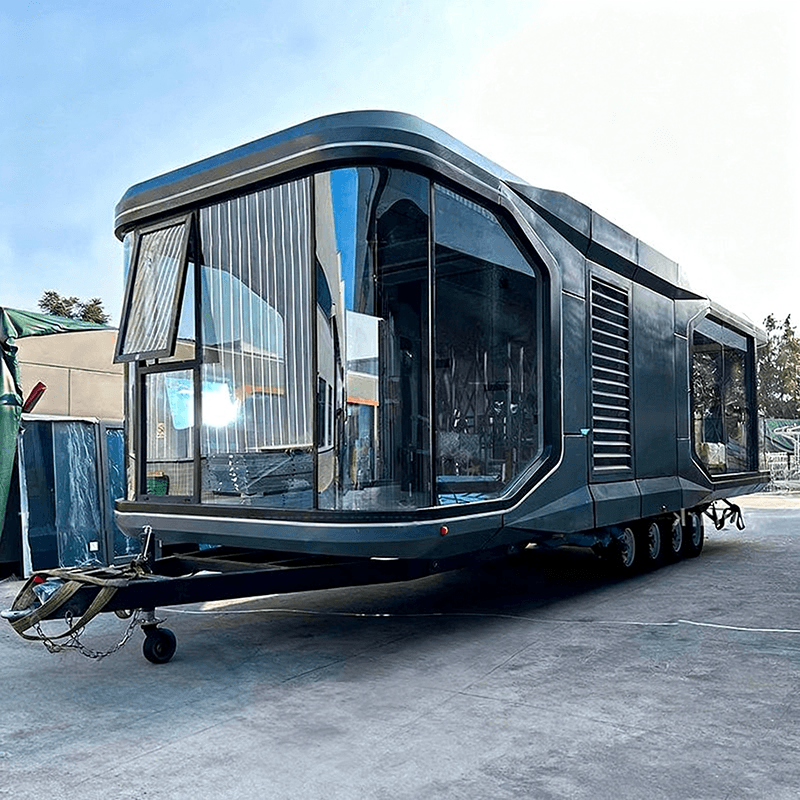
Structural Composition
The core components of an assembled mobile toilet include fecal sewage storage tanks (or disposal units), floor slabs, sanitary ware, walls, washing facilities, water tanks, roofs, and mobile devices. For example, in a simple renovation case, a plastic bucket is transformed into the core of a toilet, with a drainage system formed by installing elbows, floor drains, pipes, and valves; the water tank and spray nozzle are combined with buckles to achieve flushing functionality; the exterior is framed with wooden boards or aluminum sheets, and universal wheels are added for mobility. Large mobile toilets, on the other hand, use metal carved panel walls (such as color-matched insulated structures) and double roofs, with integrated sewage discharge, water intake, and power systems inside, and are shipped and installed as finished products.
Material Evolution
Early mobile toilets were primarily made of wood, later gradually shifting to lightweight and corrosion-resistant materials. Common modern materials include:
- Fiberglass-reinforced plastic: High strength and corrosion resistance, suitable for long-term use scenarios;
- Polyethylene: Lightweight and easy to process, with lower costs, commonly used in temporary facilities;
- Metal carved panels: Combine insulation and decorative properties, often used in high-end or cold-region products.
Classification Methods
- By structural form:
- Single-unit structure: Independent units suitable for spaces with limited area;
- Composite structure: Multi-unit combinations that can be expanded into large public toilets.
- By mobility method:
- Hoisting/handling type: Relies on lifting equipment or manual handling;
- Powered/trailer type: Equipped with engines or towing devices for autonomous movement or towing by vehicles.
- By sewage treatment method:
- Water-flush type: Requires connection to a water source, with sewage discharged into septic tanks or municipal sewage networks;
- Waterless suction type: Uses vacuum pumps to suction feces, suitable for water-scarce areas;
- Recirculating water-flush type: Filters and recirculates sewage to save water resources;
- Dry-pack type: Collects feces in biodegradable bags, requiring no flushing, with strong environmental friendliness.
Typical Application Scenarios
- Temporary events: Music festivals, exhibitions, and other short-term gathering places for rapid deployment and dismantling;
- Tourist attractions: Solves sewage disposal challenges in remote areas, such as mountains and islands;
- Emergency disaster relief: Provides basic sanitation facilities after earthquakes and floods to safeguard the health of disaster victims.
Through modular design, assembled mobile toilets achieve flexible configuration, and upgrades in materials and technology make them more adaptable to diverse needs, becoming important infrastructure in modern cities and outdoor scenarios.



