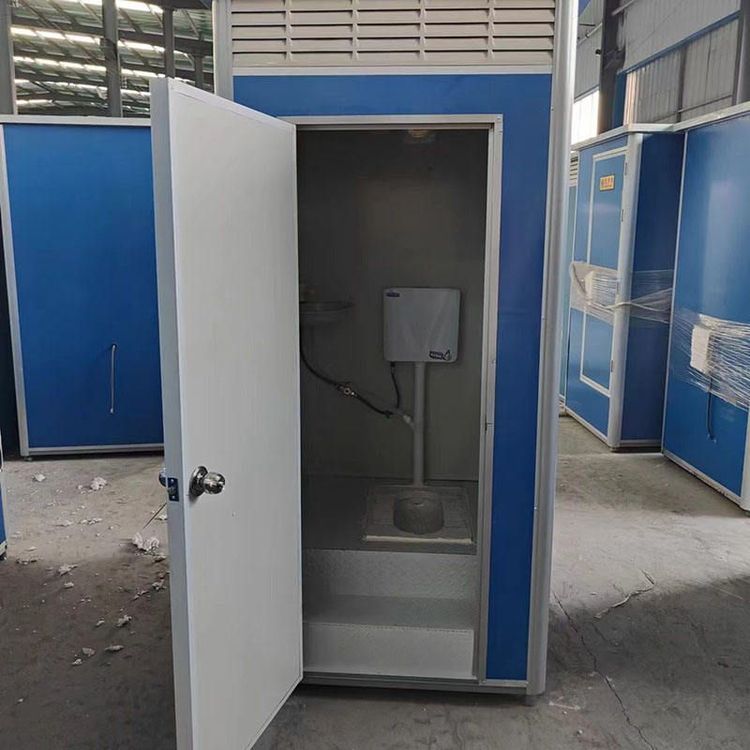
Yongqing Mobile Toilet Installation
The installation of mobile toilets in Yongqing should follow standardized procedures, typically carried out by service providers, with the rental cost including relevant services. The specific installation steps are as follows:

1. Preliminary Preparation
Before installation, confirm the site conditions: the ground should be level and solid to prevent structural deformation due to foundation settlement; the location should be away from water source protection areas (such as rivers and drinking water wells) and poorly ventilated areas to prevent sewage leakage or odor accumulation. At the same time, clear the site of debris to ensure sufficient construction space. During equipment inspection, check whether the main frame, toilet bowls, fecal storage tanks, connectors, and other accessories are complete. For flush toilets, also confirm that components of the water supply system, such as water tanks and water pipes, are intact.
2. Foundation Fixation
After hoisting the main body of the mobile toilet to the designated position, use two methods for fixation:
- Expansion Screw Fixation: Suitable for hard surfaces like concrete, drive expansion screws into the pre-drilled holes at the bottom to ensure a tight connection between the main body and the ground;
- Counterweight Block Fixation: For soft surfaces (such as muddy ground), place concrete counterweight blocks around the bottom of the main body to stabilize the structure through gravity, preventing tipping due to strong winds or human collisions.
3. Installation of Core Components
- Toilet Bowls and Sewage Systems: Fix the toilet bowls in the pre-drilled holes of the main frame and use sealing gaskets to connect the sewage outlets to the fecal storage tanks, ensuring no gaps to prevent fecal leakage;
- Water Supply/Drainage Systems: For flush toilets, connect the water inlet pipe to the water tank and install a float valve to control the water level; for dry toilets, fix the position of the fecal storage tank to ensure alignment with the sewage outlet of the toilet bowl.
4. Assembly of Auxiliary Facilities
Install doors and windows and adjust their switch flexibility to ensure a tight closure without gaps; add convenience accessories such as handrails and hooks, and lay anti-slip mats in areas prone to slipping; if the toilet is equipped with lighting or exhaust fans, connect the circuit and test the power supply to ensure safety during night use and ventilation effectiveness.
5. Sealing and Debugging
Use silicone strips to seal gaps in the main frame, around doors and windows, and other areas to prevent odor leakage; test the flushing function (for flush toilets) or the smoothness of sewage discharge (for dry toilets), and check the sealing of the fecal storage tank; clean up installation debris and place toilet paper, deodorizers, and other items in the toilet to enhance the user experience.
6. Safety Inspection
Finally, confirm that there are no loose components in the overall structure and check the fixation effect of expansion screws or counterweight blocks; post emergency contact information (such as the service provider's phone number) on the exterior of the toilet. After completion of the inspection, the toilet can be put into use.
Note: When renting mobile toilets in Yongqing County, service providers usually offer a "one-stop" service, including equipment transportation, installation and debugging, regular sewage removal, and recycling. Users do not need to operate it themselves but should confirm in advance whether the site conditions meet the installation requirements.