Back to blog
Article
Installation of Vehicle-mounted Mobile Toilets in Xinjiang
Admin September 28, 2026
The installation of vehicle-mounted mobile toilets in Xinjiang requires tailored design from foundation treatment to functional system configuration, taking into account the local special environmental conditions. The specific steps are as follows:
1. Foundation Treatment
The geological conditions in Xinjiang are complex, and the plan needs to be adjusted according to the soil type:
- Sandy Soil Areas: Use a combination of concrete bases and ground anchors to prevent structural displacement.
- Permafrost Zones: Deepen the foundation to below the permafrost layer to avoid instability caused by freeze-thaw cycles.
- Saline-alkali Soil Areas: Elevate the foundation platform and use non-metallic isolation pads or aluminum-magnesium-zinc-coated steel plates to prevent corrosion of metal connectors. The depth of foundation anchor points should exceed the lower limit of the permafrost layer.
2. Structural Assembly
Modular design simplifies on-site construction:
- Wall Panel Connections: Physically combine through tongue-and-groove joints and secure with internal slots. Seal external joints with weather-resistant sealant strips. Stagger multiple layers of materials to create a thermal break effect and reduce heat conduction.
- Roof Design: A slight curve enhances load-bearing capacity. Adjust the drainage slope according to precipitation (gentle in arid areas, increased in snowy and rainy areas with snow guards installed).
- Sealing Treatment: Install elastic sealing rings at bolt connection points. Fill joints with closed-cell foam sealant strips and cover with weather-resistant adhesive layers to accommodate material deformation caused by diurnal temperature variations.
3. Ventilation System Configuration
Utilize Xinjiang's wind resources for natural ventilation:
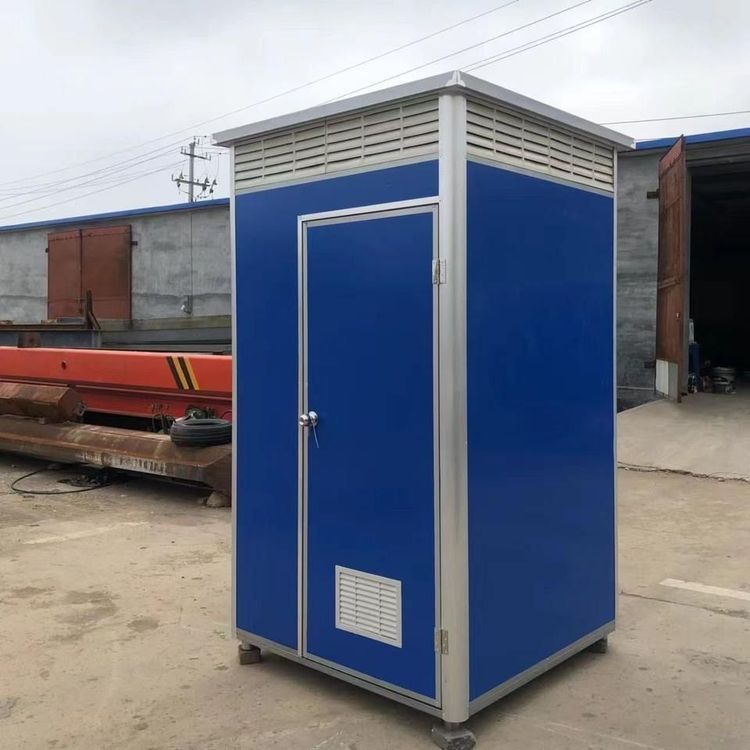
- Convection Design: Install adjustable louvers at high points on wall panels to create negative pressure ventilation.
- Sand Prevention Measures: Install sand-proof filters at exhaust ducts and panel openings, and reserve cleaning and maintenance access.
4. Internal Piping System
Split design reduces on-site construction difficulty:
- Modular Prefabrication: Prefabricate sewage, ventilation, and water supply pipes into independent modules in the factory, requiring only interface connections on-site.
- Material Selection: High-density polyethylene pipes have low expansion rates, preventing interface leakage caused by temperature variations.
5. Water Conservation and Waste Treatment
Adapt to arid environmental needs:
- Water Conservation Technology: The flushing system uses pneumatic boosting, and the sink's sensor-based flow restrictor limits single-use water to ≤0.5 liters. Some models collect sink wastewater for secondary flushing, achieving a 70% water conservation rate.
- Waste Treatment: Solid-liquid separation devices combine biological degradation (with added microbial agents) and physical filtration. The liquid undergoes multi-stage treatment for non-potable use, reducing the frequency of emptying.
6. Other Key Details
- Lighting Wiring: Lay wiring in dedicated cable trays to prevent short circuits caused by condensation.
- Ecological Protection: Use a suspended foundation (adjustable steel supports + enlarged load-bearing plates), eliminating the need for excavation and allowing rapid surface recovery after relocation.