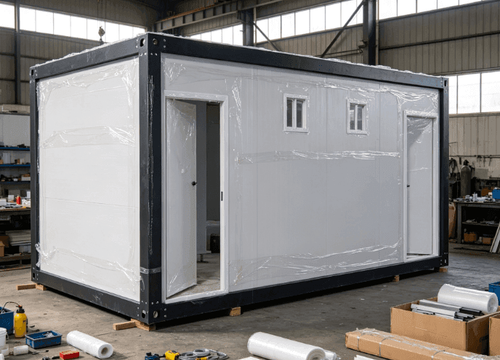
Demolition of Cement Prefabricated Houses in Xinjiang
The demolition of cement prefabricated houses in Xinjiang must adhere to professional procedures and standards, covering aspects such as dangerous building identification, selection of demolition methods, and waste disposal.

I. Dangerous Building Identification and Disposal Procedures
Before demolition, a professional institution must evaluate the building in accordance with the "Standards for the Appraisal of Dangerous Buildings." If the appraisal result is Grade C (partially dangerous) or Grade D (overall dangerous), the relevant department will initiate procedures for handling dangerous buildings to confirm the necessity of demolition. This step is a prerequisite for legal demolition, preventing legal risks arising from unauthorized demolition without identification.
II. Core Methods of Demolition Operations
Non-Explosive Demolition Techniques
- Hydraulic Breaker: Driven by a hydraulic system, the impact head generates high-frequency impact force on concrete, suitable for breaking structures such as walls and floors. Its advantages include flexible operation and high efficiency, but the impact frequency must be controlled to minimize vibration effects on surrounding structures.
- Diamond Saw Cutting: Utilizes a saw blade embedded with diamond particles for linear cutting, suitable for scenarios requiring the retention of partial structures or precise segmentation (e.g., beam-column connections). The cutting depth can exceed 1 meter, but it requires a water cooling system to prevent the saw blade from overheating.
- Static Blasting: Expansion agents are injected into drilled holes in the concrete, causing the structure to crack under the pressure generated by slow expansion. This method involves no explosive impact and is suitable for vibration-sensitive areas such as hospitals and schools, but the dosage and action time of the expansion agents must be calculated in advance.
Demolition Techniques for Special Scenarios
- Layer-by-Layer Demolition of High-Rise Buildings: Utilizes aerial work platforms (e.g., scissor lifts) in conjunction with small breakers to demolish the building from the top floor downward layer by layer. Protective nets must be erected in advance to prevent debris from falling, and temporary support structures must be installed to ensure stability.
- Handling of Large-Volume Concrete Foundations: Adopts drilling and splitting techniques, where holes are drilled into the foundation using a drilling machine, and splitters are inserted to apply lateral force, causing the concrete to split along the holes. This method reduces the use of large machinery and minimizes compaction damage to the surrounding ground.
III. Environmental Protection and Safety Control Measures
- Waste Resource Utilization: Concrete blocks generated from demolition can be processed by crushers into recycled aggregate, used for roadbed filling or the preparation of low-strength concrete, reducing the volume of construction waste sent to landfills.
- Dust and Noise Control: In urban areas, water spraying systems must be equipped to continuously moisten the crushing area and reduce dust; soundproof barriers should be set up to minimize noise diffusion, ensuring compliance with the "Emission Standard for Environmental Noise at the Boundary of Construction Sites."
- Personnel Safety Training: Operators must undergo professional training to familiarize themselves with machinery performance (e.g., hydraulic system pressure adjustment, saw blade replacement procedures) and safety protocols (e.g., fall prevention measures for aerial work, protective measures for expansion agent use), preventing structural collapse or personnel injuries due to operational errors.