Waterless Mobile Toilet Installation Plan
The installation plan for waterless mobile toilets needs to be combined with site conditions and technical adaptability, achieving rapid deployment through modular assembly. The specific process is as follows:

1. Site Assessment and Basic Preparation
Before installation, a comprehensive assessment of the site is required, focusing on checking the terrain flatness, ground bearing capacity, and waste removal paths. If the ground is uneven or the bearing capacity is insufficient, a simple hardened foundation (such as a concrete pad or steel plate) needs to be laid to ensure the stability of the toilet unit. At the same time, plan the removal routes to avoid obstructing subsequent maintenance. In addition, estimate the expected foot traffic and service cycle to determine the number of units and the amount of consumables to be stocked. For example, large event venues need to reserve spare units to cope with peak demand.
2. Equipment Adaptation and Configuration
Select appropriate waterless treatment technologies based on site parameters. Common types include:
- Dry degradation technology: Requires the addition of microorganisms or plant-based materials to achieve solid waste reduction through biological decomposition.
- Packaging and sealing technology: Equipped with biodegradable films to seal and store excreta, reducing odors.
- Chemical solidification technology: Uses specific agents to solidify liquids, preventing leakage.
When delivering the equipment, ensure that mechanical components (such as exhaust fans and sensors) function properly and pre-install necessary consumables (such as degradation bacteria and film rolls).
3. Modular Assembly and Fixation
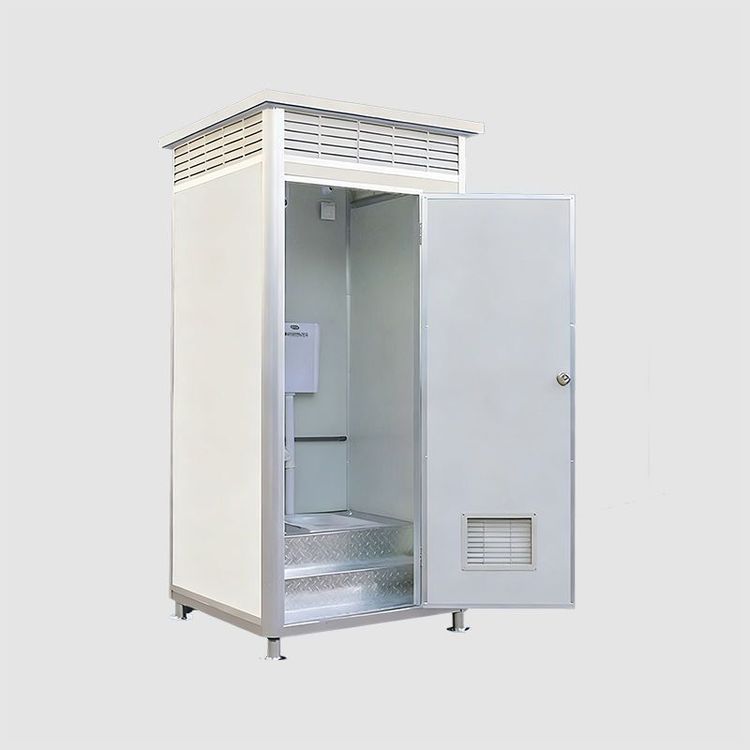
Waterless mobile toilets adopt a standardized box structure, and the assembly process is as follows:
- Basic treatment: Level the ground and set up safety barriers. Connect an independent power supply unit (such as solar panels or batteries) to drive internal equipment.
- Box positioning: Use lifting equipment or pulley systems to hoist the modular boxes to the designated positions, ensuring that the boxes are level and the sewage outlets are aligned with the preset conduits.
- Unit integration: Connect the solid-liquid separation, treatment, and storage units through pipes and sealed interfaces to form a complete treatment chain. The bottom of the boxes is usually equipped with sturdy bases or wheels for easy transportation and secondary deployment.
4. Ventilation and Sealing Optimization
Block odor overflow through an independent ventilation system:
- After the liquid is collected through conduits, it needs to undergo adsorption (such as activated carbon filtration), chemical neutralization (such as adding deodorants), or biological degradation treatment.
- The solid part is reduced in volume through sealed storage or microbial decomposition. Rubber sealing rings are used at the interfaces of the boxes to prevent leakage.
5. Logistics and Long-term Maintenance
The service provider needs to coordinate the entire process of transportation, installation, inspection, and recycling:
- The contract clearly defines maintenance responsibilities (such as equipment maintenance and consumable replenishment) and the waste removal cycle.
- Regularly check the performance of the ventilation system, seals, and treatment units to ensure the long-term stable operation of the equipment.
This plan achieves the rapid deployment of waterless mobile toilets in temporary venues (such as outdoor construction sites and music festivals) through modular design and on-site adaptation, while taking into account environmental protection and hygiene requirements.