Want Amenities for Your Sports Park or Stadium? Skip Concrete Headaches—Modular Containers Are the Smart Choice
If you run a sports park or stadium, you may know this kind of frustration all too well.
You finally get the site planned, the turf laid, the track finished, and the courts marked—then you want supporting amenities: a rest area for athletes, locker rooms, a staff service center, maybe a small retail corner for water and gear to lift the whole experience. Then land quotas hit, and everything stalls: the application can drag on for half a year or more, approval is never certain; even if you get it, traditional concrete takes another half year to build—time you cannot afford and capital that stays locked up. Worse, if the site plan changes later, finished amenities are hard to remove and hard to keep—they become dead weight, money and effort wasted.
You do not have to fight land quotas forever. Operators who stay ahead have already switched approaches—sports parks, Alibaba Orange Lion Sports, school stadiums, and large event venues are quietly using modular prefabricated container structures instead of traditional concrete for supporting facilities.

Honestly, the first time people hear that containers can serve as sports amenities, they share the same doubts: are these not just steel boxes for shipping? Will they work? Will they look crude and wear out fast? After seeing real projects, it becomes clear this is a solution tailored for sports support—it hits the pain points, and operators who try it tend to stick with it.
Here is a plain talk on why more sports venues are leaving concrete behind for modular prefabricated containers: no land-quota scramble, no endless build schedule, spaces you can customize, and units you can move and reuse—practical tools for sports operators.

A hard truth first: traditional concrete amenities are often a trap.
Sports support needs are simple at the core: practical, fast, cost-effective, and flexible. Traditional concrete tends to fail on all of them.
Start with land quotas—the old headache. Land is scarce; whether it is an urban sports park or a school stadium, applying for new construction land for amenities can wear you down. From submission and review to final approval, it often takes six months to a year. Many projects stall simply because they cannot wait. Temporary event sites—marathons, multi-sport meets—only need temporary amenities and never needed permanent land quotas, yet concrete becomes fixed once built and is hard to remove, which does not fit temporary use.
Then comes the schedule—slow and draining. From foundations, rebar, and pours to fit-out, concrete rarely finishes in under 3–6 months. Every day amenities are incomplete is a day of weaker experience, fewer visitors, and lost revenue. Rain and winter can stop work, schedules slip again, and capital pressure grows.
Flexibility is poor—a one-shot deal. Once built, concrete stays put. If you later want to move a lounge or expand retail, you cannot; you tear down and rebuild at real cost. When a temporary event ends, keeping the structure wastes space and removing it feels wasteful—classic sunk cost.
Cost adds up too: materials, labor, construction, and maintenance are all heavy. Upfront spend is high, and later changes cost again—often too much for mid-size venues or short events.

Modular prefabricated containers hit those needs instead—filling the concrete gaps and adding more upside.
First, what operators care about most: they do not consume permanent land quotas—and that matters.
People ask whether placing containers on a site still counts as land use. Modular prefabricated containers are treated as temporary movable facilities: they do not require permanent construction-land quotas or long approval chains. When they fit the site plan, a simple filing is often enough to deploy.
Under relevant policy, temporary container-type infrastructure can follow a notification-and-commitment approach: when the builder meets the requirements, temporary construction approval can be issued quickly, without endless land-quota chasing. For sports parks and school stadiums short on land, that is real relief—you need not abandon better amenities for lack of quota, or delay the project while waiting for land.
Take Alibaba Orange Lion Sports: multiple Ledongli sports parks nationwide—such as Xuhui West Bund Ledongli Wind Valley Sports Park and Ledongli Xindu Sports Center—use container amenities. Many sit in dense urban cores with almost no spare land for concrete support buildings. Container amenities solve that: no permanent land quota, fast deployment, better service without breaking land rules.

Ordos Vitality Waterfront Park used shaped prefabricated modules as sports-park amenities—no land-quota application along the way, later removed and relocated with no lasting footprint, leaving the site free for future use—clean and low-stress.

For school stadiums, this is often a must. Many schools want locker rooms, showers, or staff lounges, but campus land is limited and quotas are hard. Container amenities can go in quickly without tearing up the campus layout or waiting through long approvals, so students get better support without extra land cost.

Second, schedules are strikingly short—ready in 30–45 days—no long wait.
Sports operators are short on time. Concrete can take half a year; modular prefabricated containers use factory prefabrication plus on-site assembly. About 90% of the work happens in the factory—structure, interiors, and MEP are finished there, then units ship to site for simple assembly and commissioning.
Typically, a full amenity package from design and prefabrication to on-site handover takes 30–45 days; the fastest jobs finish in a little over 20 days—cutting schedules by more than 80% versus concrete. That means you lock a plan today and, about a month later, athletes have comfortable lounges and clean lockers, staff have a working service hub, and the venue gains competitiveness quickly.
Weather barely slows the process: factory work continues in rain or winter, and site work is mainly lifting and fixing. For temporary events, that speed is decisive—for a one-week games meet, start containers a month ahead, finish on time, then remove them quickly so the site can return to normal use.
Shorter builds also mean faster capital turnover: money returns sooner instead of sitting idle—especially helpful for mid-size venues.
Next is custom function—nearly any space you need can be tailored.
Many still picture crude steel boxes. Today’s modular prefabricated containers are highly customizable: whatever support space you need can be matched with both looks and practicality.

Common sports-site support spaces are all within reach:
A service center can combine reception and offices—simple, comfortable interiors with desks, computers, and printers so staff can welcome guests and handle daily work, plus an information desk for athletes. At Orange Lion’s Wind Valley Sports Park on the West Bund, the container zone includes service and inquiry functions with self-serve retail and power banks, lifting the visitor experience.
A lounge can be single, double, or multi-seat layouts with sofas, chairs, and tables, plus HVAC and fresh-air systems so people can recover after exercise. The Shanghai Marathon container rest area included acoustic layers, adjustable lighting, charging ports, and drinking water to help runners reset quickly.
Locker rooms and showers are core sports amenities. Containers can be fitted with multiple private changing bays with lockers and seats; showers get fixtures, heaters, and non-slip floors with proper waterproofing—clean and hygienic, on par with concrete rooms. Bay counts flex with footfall to avoid crowding.
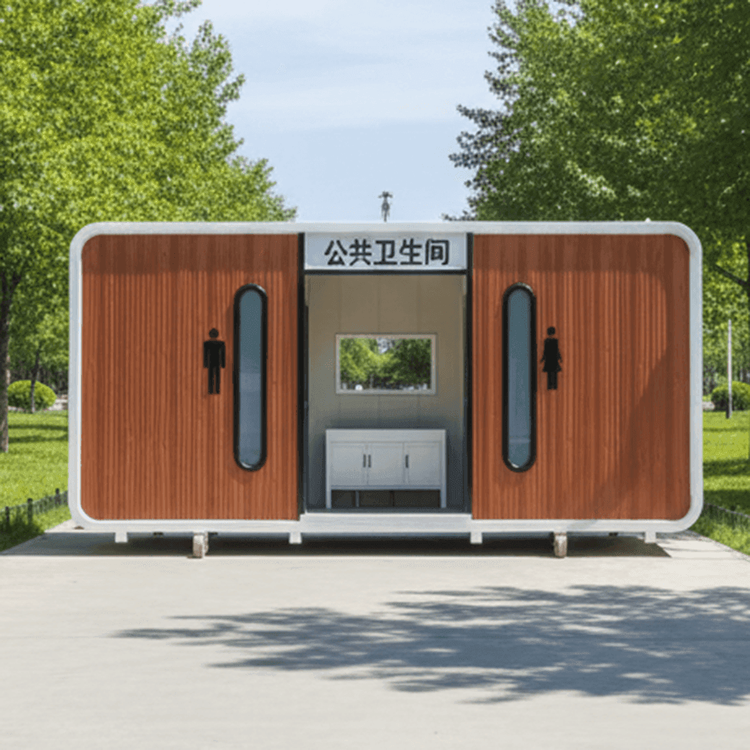
Restrooms can be mobile or fixed units with toilets, sinks, mirrors, and drainage—clean solutions for urgent needs. In outdoor sports parks, container restrooms are especially handy: no complex sewer runs, flexible placement, and easy relocation later.
You can also customize retail—a mini convenience store for water, drinks, snacks, and gear; a tea or coffee shop for a warm drink after training; even a small creative shop for venue merch and extra revenue. Beside a smart fitness cabin in Shenzhen’s CBD, a small retail space links sport and spending seamlessly.

Containers can also stack and combine—lounge over lockers, or service plus retail—to save footprint while covering more functions. Denmark’s Halskov water sports center stacked three containers as diving-tower support, rotating each for both utility and design, turning them into a landmark.
Customization is straightforward: tell our company what you need—functions, size, style—and a professional design team builds a tailored plan covering layout, finishes, and MEP as a one-stop service. The team surveys the site, builds accurate 3D models, and optimizes box layout for the conditions so amenities work well, look right, and fit the place.

Another major plus: after use, units can be relocated and reused—greener, cheaper, and high value.
Concrete stays put; moving it means demolition and rebuild—waste of material and money. Modular prefabricated containers are movable and reusable—“mobile amenities.”
For temporary events such as marathons or multi-sport games, containers can be lifted and shipped to the next event or another sports site. One international marathon used 30 custom containers; after the race, 80% of units were converted into community sports facilities—circular use that cut waste and cost.
If a sports park later shifts its plan, lounges or retail can be crane-lifted, moved, and reassembled without a full rebuild—saving time and capital. Shenzhen’s smart fitness cabins, with hydraulic lift systems, can relocate in about three hours to match changing urban space.
Service life is long: frames of 1.6–2.0 mm weathering steel, after anti-corrosion treatment, can last 50 years or more, with annual maintenance about 40%–60% lower than traditional buildings. With routine care, decades of reuse are realistic. When retired, steel can be recycled, aligning with dual-carbon goals—green and economical.
Reuse also lowers upfront cost. For temporary events, rent a container package instead of building permanent concrete; return it or move it onward—pay once, use many times. Schools facing enrollment or program shifts can relocate and reconfigure without wasting earlier investment.

Some still ask: will containers hold up? Will they overheat in summer and freeze in winter? Is sound isolation poor?
Those issues are largely solved in modern modular prefabricated containers.
For thermal comfort, professional insulation plus well-sealed doors and windows keep summer heat out so AC cools quickly, and hold winter warmth indoors—matching or beating ordinary concrete comfort. Shenzhen’s smart fitness cabins pair fresh-air systems with AC preset to about 26°C for a comfortable feel.
For acoustics, steel already helps, and internal sound layers further cut crowd noise and footfall so lounges and lockers stay quieter for rest.
For durability, high-strength steel resists force-8–10 winds and magnitude-6 quakes, with snow-load standards ≥0.7 kN/㎡—stable outdoors in harsh weather. Anti-corrosion and anti-rust finishes slow aging. CIMC modular buildings have even reached 40-story permanent structures with about 50-year service life—strong evidence of durability.
On sustainability, container buildings can reach about 98% material recovery as a circular-economy model; one 40-ft unit can cut about 3.5 tons of steel use and lower carbon emissions by about 65% versus traditional construction. On-site assembly produces little construction waste and keeps parks cleaner—a strong fit for environmentally conscious sports venues.

After all that, some still assume the price must be high.
Often the opposite is true: modular prefabricated containers cost less than expected.
Short schedules cut labor and site costs; skipping permanent land quotas saves approval and land-lease spend; reuse avoids rebuild spend when layouts change; materials can cost less than concrete, and factory standardization plus bulk buying lowers cost further.
More sports venues already see the upside and choose container amenities:
Alibaba Orange Lion Sports, a benchmark sports operator, uses containers across Ledongli parks—for example the orange container rest zone at Xuhui Wind Valley Sports Center with AED, emergency meds, and self-serve retail: better service, lower cost, and a popular photo spot. The roughly 300-square-meter container function zone at West Bund Wind Valley Sports Park covers rest, dining, and gathering—sport social spaces that build new consumption scenes.

Donghua University’s football field also brought in container amenities—locker rooms and showers for students, meeting space for coaches—without land quotas, delivered quickly, fixing gaps in school sports support and improving the experience for students and staff.

Large events such as the Shanghai Marathon and city games use containers for temporary amenities, then remove and relocate them so the site returns to normal use—green, efficient, and lower operating cost.
Outdoor sports parks, golf ranges, and water sports centers have followed. Shanghai Yangpin Architecture’s custom container rest area for a golf range used transparent glass curtain walls and lightweight structure for open views while blocking glare and weather, blending into fairways and greens. Denmark’s Halskov water sports center stacked containers as diving-tower support—practical, designed, and iconic.

These cases show modular prefabricated containers are becoming the new mainstream for sports amenities: they clear concrete pain points—no land-quota struggle, no endless build, custom spaces, relocation and reuse, and strong value—an ideal path for sports operators.
Sports amenities do not have to mean sticking with concrete. With tight land quotas, precious time, and capital pressure, modular prefabricated containers are a fit-for-purpose answer—no permanent land quota, 30–45-day delivery, customizable spaces, movable and reusable, durable and greener, often at lower cost.
Imagine no more land-quota errands, no schedule anxiety, less capital stress—and in a little over a month, complete amenities that lift experience, draw visitors, and grow revenue. Why wait?
Alibaba Orange Lion Sports, schools, and event venues have already moved to this approach. What are you waiting for?
Do not stay boxed in by land quotas or slowed by concrete. Choose modular prefabricated container structures so amenities land easier, faster, and cheaper—making your venue more competitive and giving athletes a better experience.
Whether you run a sports park, stadium, school field, or event venue—and whether you need a service center, meeting room, lounge, locker room, showers, restrooms, or retail—our company can custom-build a one-stop package from design and prefabrication to handover, so you get complete sports amenities with less hassle and unlock new operating potential.