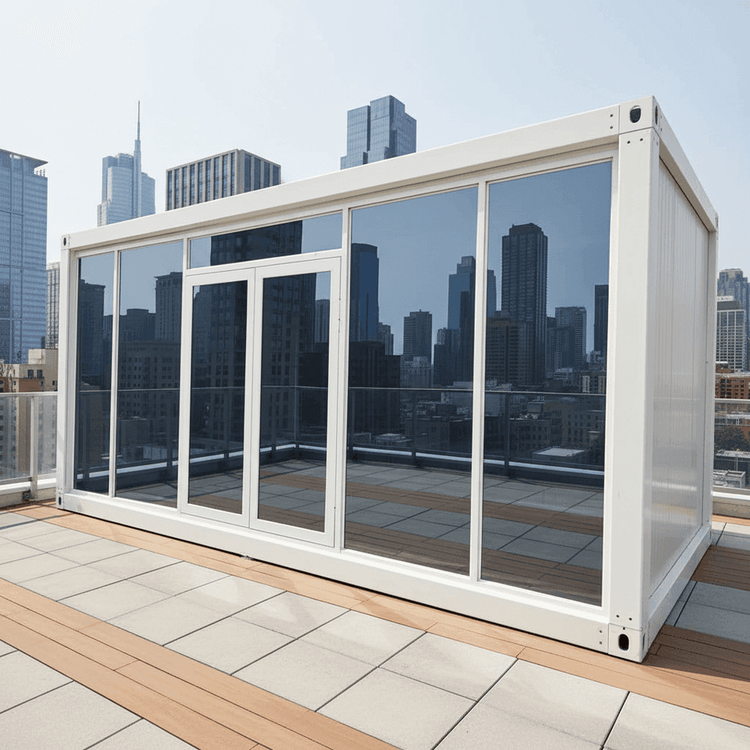
Typhoon-Resistant Container House
Typhoon-resistant container houses can effectively withstand typhoon attacks through structural reinforcement, material optimization, and standardized installation measures, with wind resistance capabilities reaching above Level 12, and some products even able to resist strong winds of Level 13.

1. Structural Reinforcement Technology
The core of the wind resistance performance of container houses lies in the frame structure. All-steel frame structures are the mainstream design. For example, the Suzhou Zhongnan Quick-Assembly Container uses high-strength steel welding, which has been tested to withstand winds of Level 12 and has an earthquake resistance rating of Level 8, complying with the GB50011-2010 Building Seismic Design Code. Its corners are rounded to avoid stress concentration, further enhancing structural stability. Modular connection methods are also crucial. Upper and lower layers of containers are fixed with twist locks, and the same layer is horizontally connected using tie rods or steel wires to ensure integrity. For example, a project in Hainan used customized container stacking, with bolt connections between containers combined with steel frame channel steel reinforcement, significantly improving wind resistance.
2. Material and Process Optimization
Exterior wall materials directly affect wind resistance. High-quality container houses adopt a steel plate sandwich panel structure, with an outer layer of corrosion-resistant steel plate and an inner layer filled with fire-resistant rock wool or polystyrene, ensuring both strength and thermal insulation. Weld-free quick-assembly processes can reduce structural weaknesses and lower the risk of fracture under typhoon impact. For example, a manufacturer in Shanghai achieves millimeter-level modular production precision, ensuring tight seams between container bodies, reducing wind pressure penetration, and achieving a wind resistance rating of Level 13.
3. Installation and Reinforcement Specifications
Foundation treatment is the foundation of wind resistance. The site needs to be leveled and hardened, with a concrete thickness of no less than 15 cm, and drainage ditches set up to prevent water accumulation from softening the foundation. Stacking methods need to be scientifically planned, with container stacking not exceeding 4 layers, anti-slip pads placed between layers, and anti-collision posts or sandbags installed at the ends. Dynamic reinforcement is aimed at transportation scenarios, such as using tie straps to fix containers to vehicles, evenly distributing internal cargo to avoid center-of-gravity shift, and immediately stopping in a safe area for reinforcement when a typhoon warning is issued during transit.
4. Maintenance and Early Warning Mechanisms
Regular inspections can promptly identify hidden dangers, such as loose twist locks and steel corrosion. Typhoon warning responses require the development of emergency plans, including reinforcing all connectors, transferring valuable items, and preparing emergency supplies. For example, the "Technical Guidelines for Wind Resistance Reinforcement of Temporary Housing" issued by the Guangdong Provincial Department of Housing and Urban-Rural Development clearly requires a comprehensive inspection and reinforcement of container houses before a typhoon.