Construction of Mobile Toilets in Xinjiang Scenic Areas
The construction of mobile toilets in Xinjiang scenic areas mainly includes foundation treatment, panel splicing, pipeline system installation, and adherence to the principle of minimal disturbance.

Foundation Treatment: Xinjiang covers a vast area with diverse and complex geological conditions. In sandy soil regions, due to the loose soil and poor structural stability, a combination of concrete foundations and ground anchors is used. The concrete foundation provides a solid base support, while the ground anchors penetrate deep into the ground to enhance the overall structural stability, preventing the mobile toilet from shifting due to external forces. In permafrost zones, freeze-thaw cycles can lead to unstable foundations, so the foundation depth needs to be increased to ensure stability during freeze-thaw processes. Compared to the deep foundation construction of fixed toilets, the foundation treatment for mobile toilets reduces earthwork excavation and improves construction efficiency.
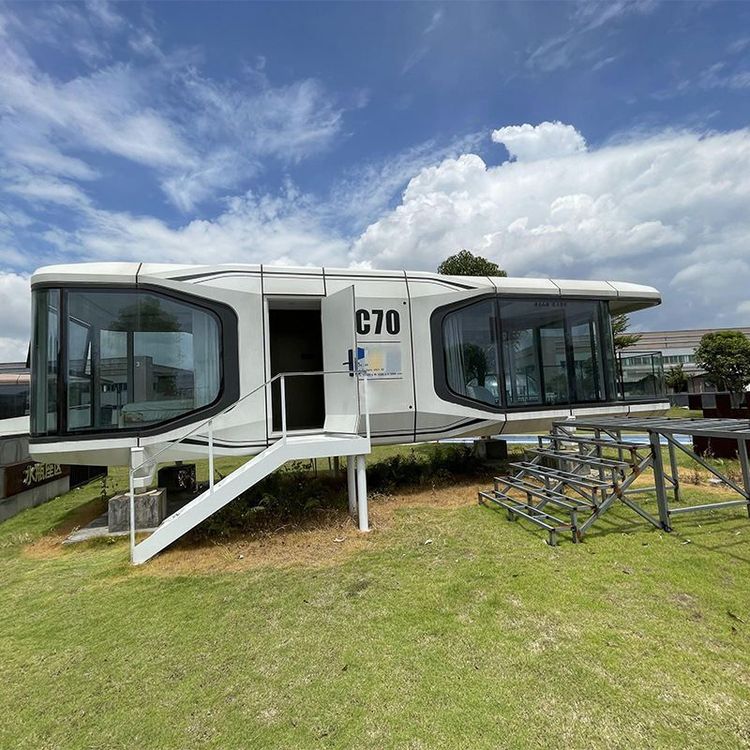
Panel Splicing: Color-coated steel panels are one of the commonly used materials for mobile toilets. During the splicing process, hidden fastening technology is employed, with wall panel connections completed through internal slots, ensuring both firm connections and a smooth, aesthetically pleasing appearance of external seams. External seams are treated with sealing strips for waterproofing, effectively preventing rainwater infiltration. The roof panels are designed with a slight curve, which not only enhances the roof's load-bearing capacity but also effectively channels rain and snow. Compared to the flat roof design of traditional prefabricated temporary buildings, this design allows snow to slide off more easily, reducing the roof load and extending the service life of the mobile toilet.
Pipeline System Installation: The internal pipeline system of mobile toilets adopts a modular design, with sewage pipes, ventilation pipes, and water supply pipes prefabricated as independent modules in the factory, requiring only interface connections on-site. This design significantly simplifies the construction process and improves efficiency. The pipeline material is high-density polyethylene, which has a low expansion rate in environments with large temperature variations, avoiding interface leakage caused by thermal expansion and contraction. Compared to the on-site welded pipelines of traditional toilets, the modular pipeline system is more convenient for maintenance, allowing for the separate replacement of faulty modules and reducing maintenance costs.
Adherence to the Principle of Minimal Disturbance: In ecologically fragile areas of Xinjiang, the construction of mobile toilets must adhere to the principle of minimal disturbance. Construction machinery is restricted to specific routes to avoid crushing vegetation and protect the ecological environment. On-site concrete mixing is avoided, and all prefabricated components are assembled directly upon arrival, reducing dust and noise pollution during construction and achieving green construction.