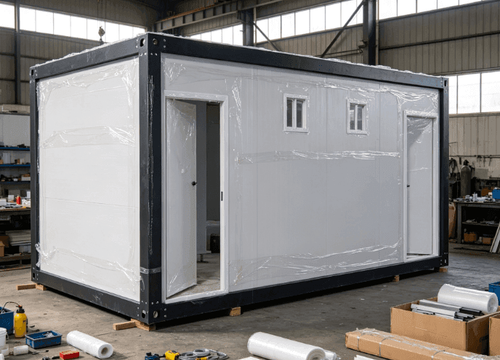
Super Mobile Toilet Manufacturing
The manufacturing methods of super mobile toilets mainly fall into two categories: handmade production and commercial customized production, with specific steps and key points as follows:

Handmade Production Method
Handmade super mobile toilets typically utilize common materials such as water storage tanks and pallets, suitable for individual or small-scale needs. Specific steps include:
- Basic Frame Construction: Fix universal wheels at the bottom of the pallet to ensure mobility; the pallet, as the bottom support structure, should be made of materials with strong load-bearing capacity.
- Water Storage Tank Modification: Place and cut the water storage tank to form an open tank body. Stack and fix two water storage tanks to increase internal space; cut out a doorway for personnel access, ensuring smooth edges to avoid scratches.
- Internal Facility Installation: Drill holes in the internal floor and install a drainage system connected to the water storage tank or external drain; secure the toilet (a simple squat toilet or sit toilet can be chosen), install faucets, sinks, and water tanks. Some designs may include a showerhead to meet showering needs.
- External Enclosure and Decoration: Install a door (such as a folding door or sliding door) to ensure privacy. The walls can be wrapped with waterproof panels or canvas around the water storage tank, and a waterproof cloth or lightweight panel can be added to the roof.
Commercial Customized Production Method
Commercial production focuses more on functional diversity and structural standardization, suitable for large-scale or specific scenario needs. Core components include fecal sewage storage tanks (or disposal devices), floor panels, sanitary ware, walls, washing equipment, water tanks, roofs, and mobile devices.
- Structural Form Classification:
- Single Structure: Independent unit design, suitable for scenarios with limited space;
- Composite Structure: Modular combination, expandable to multiple toilet stalls or additional shower rooms.
- Mobility Classification:
- Lifting/Handling Type: Relies on lifting equipment for movement, suitable for frequent adjustments at fixed locations;
- Powered/Trailer Type: Equipped with an engine or towing device, capable of autonomous driving or being towed by a vehicle.
- Sewage Treatment Classification:
- Flush and Non-flush Suction Type: Relies on water tank flushing or vacuum suction for sewage disposal;
- Recirculating Flush Type: Reuses water resources through a filtration system;
- Dry Packing Type: Uses biodegradable bags to collect feces, requiring no flushing.
Design principles should adhere to mobility, cost-effectiveness, durability, environmental protection, and humanitarianism. Material selection should be lightweight yet sturdy (such as aluminum alloy, fiberglass reinforced plastic). The structure should control height and width to meet transportation standards, and mobile devices (such as axles, towing hooks) should be reasonably laid out to ensure stability. Product prices in the market vary greatly (from 100 yuan to 6000 yuan), and types such as integrated steel plate box, eco-friendly, or high-end shower rooms can be customized according to needs.