
Shifang Container-style House
The Shifang region offers services related to container-style houses, covering second-hand transactions, leasing, customization, and multi-functional application scenarios. The following analysis is conducted from the perspectives of service types, product features, application scenarios, and price ranges:
1. Second-hand Container Trading and Leasing Services
In the Shifang area, there are wholesale leasing and sales services for second-hand containers, with some merchants explicitly indicating that their service coverage includes Shifang. These containers are primarily used for temporary needs, such as construction site dormitories, warehousing, or event venues, and are characterized by low cost and flexible turnover. For example, a standard second-hand container measures 3m (width) × 6m (length) × 2.8m (height), with a building area of 18 square meters and a self-weight of 1.5 tons. It can be transported in bulk using flatbed trucks (e.g., a 17.5-meter truck can carry 20 units), reducing logistics costs.
2. Modular and Customized Container Houses
Modular container-integrated houses are designed with standardization, manufactured in factories, and installed in modules, integrating architectural, structural, electrical, and decorative functions, and supporting mobility, turnover, and repeated assembly. For example:
- Homestays and Residences: Utilizing 3.2m × 6m containers for renovation, these houses come with full interior decoration and can be occupied once water and electricity are connected, making them suitable for homestays, self-built houses, or rural retirement homes;
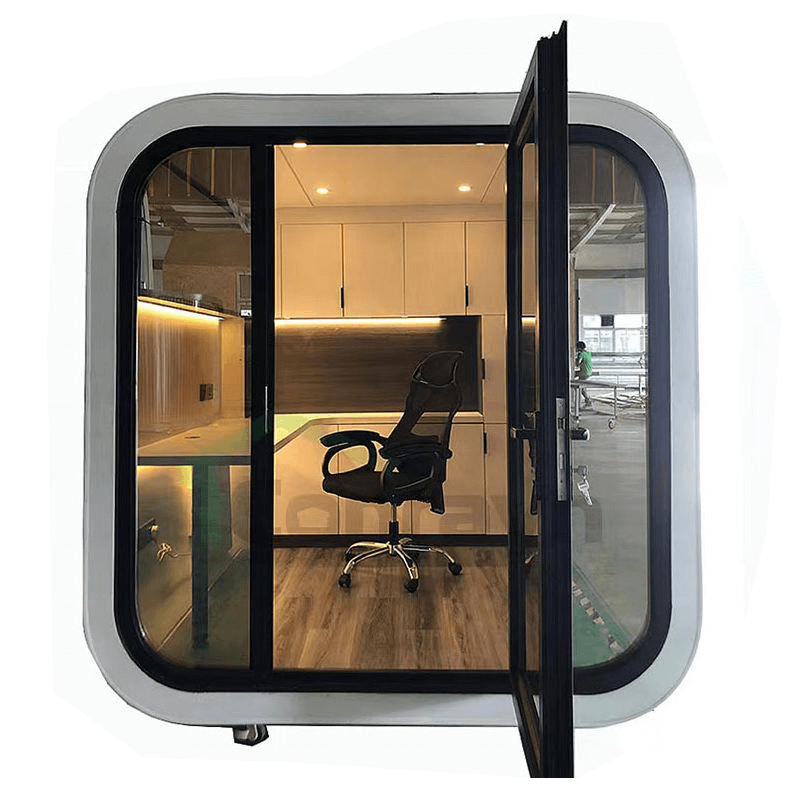
- Multi-functional Boxes: Their applications cover temporary facilities, commercial spaces, residences, and public spaces, such as Chinese-style multi-functional boxes with screens and Apple Pod container homestays, achieving spatial expansion and functional diversification through combination;
- Cultural Tourism and Commercial Buildings: Incorporating Sichuan regional elements (e.g., gray-tiled eaves and lattice walls), these buildings adopt prefabricated construction techniques, shortening the construction period (e.g., completing cultural tourism buildings within 45 days) and supporting new energy accessories such as photovoltaic panel interfaces.
3. Technical Advantages of Foldable Containers
Foldable containers solve water leakage issues through V-shaped male-female interlocking designs, can be unfolded by a single person in 5 minutes, save more than five times on transportation costs compared to ordinary containers, save ten times on storage space, and have a service life of over 20 years. Their structure features a galvanized formed base and A-grade fire-resistant rock wool color-steel sandwich panel walls, with a wind load resistance of 0.55kN/㎡, complying with the GB/T23932-2009 standard, and are suitable for emergency housing, earthquake relief, and rural dilapidated house renovations.
4. Price Ranges and Cost Optimization
The prices of container houses vary significantly depending on specifications, materials, and functions:
- Basic Type: Such as outdoor construction site K-type prefabricated houses, priced at approximately 90 yuan per square meter;
- Mid-range Type: Temporary offices or residential houses with decoration, priced at approximately 300-320 yuan per square meter;
- High-end Customization: Such as double-story quick-assembly box homestays or commercial buildings with photovoltaic accessories, with prices reaching 36,800 yuan per unit or higher.
Foldable containers further reduce usage costs through reduced welding parts, simplified installation processes, and reusability, offering significant advantages over traditional color-steel houses.



