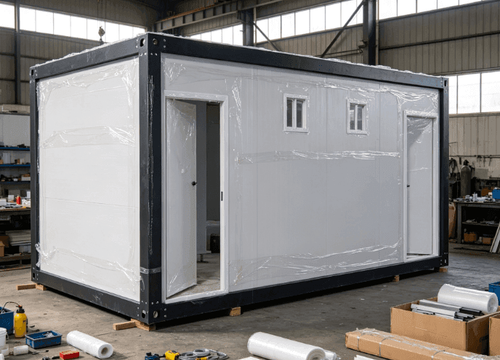
Dimensions of Portable Toilets at Construction Sites in Shanghai
The dimensions of portable toilets at construction sites in Shanghai vary depending on the type and usage requirements. Common standard dimensions can be categorized into three types: single-unit, multi-unit combinations, and special-needs toilets, as detailed below:

1. Single-Unit Portable Toilet Dimensions
Single-unit portable toilets are the most basic configuration at construction sites, designed to balance user comfort and space efficiency. The standard width of a single-unit toilet typically ranges from 1.0 to 1.2 meters, with a depth of 1.0 to 1.5 meters and a height of 2.0 to 2.5 meters. For example, a standard single-person portable toilet measures 110 cm in length, 110 cm in width, and 230 cm in height, while a mini single-person model is further compressed to 100 cm in length, 100 cm in width, and 220 cm in height to accommodate space-constrained scenarios. Additionally, some standard single-person portable toilets have external dimensions of 1.2 meters (length) × 0.8 meters (width) × 2.2 meters (height), optimizing transportation and installation convenience while ensuring basic functionality.
2. Multi-Unit Combination Portable Toilet Dimensions
Multi-unit combination portable toilets meet higher foot traffic demands by increasing the number of stalls, with overall dimensions expanding accordingly. The width of a double-stall portable toilet typically ranges from 2.0 to 2.4 meters, with a depth consistent with single-unit toilets (1.0 to 1.5 meters) and a height maintained at 2.0 to 2.5 meters. For example, a double-person portable toilet measures 180 cm in length, 110 cm in width, and 230 cm in height, while its external dimensions may be adjusted to 1.5 meters (length) × 1.2 meters (width) × 2.3 meters (height) to balance space and stability. Such designs are commonly found at medium-sized construction sites or temporary event venues, requiring modular assembly for rapid deployment.
3. Special-Needs Portable Toilet Dimensions
For special scenarios such as barrier-free access and family use, portable toilets must adhere to higher standards. Barrier-free toilets require a width of at least 1.5 meters and a depth of at least 1.8 meters to ensure wheelchair maneuverability and auxiliary equipment operation. For example, a typical barrier-free portable toilet measures 180 cm in length, 150 cm in width, and 240 cm in height, featuring a more spacious interior and a door width of at least 0.9 meters for easy wheelchair access. Additionally, some construction sites may customize larger portable toilets, such as those incorporating storage or management rooms, with dimensions adjusted according to specific needs.
Summary: The selection of portable toilet dimensions at construction sites in Shanghai should consider usage scenarios, foot traffic density, and special requirements. Single-unit toilets prioritize compactness, multi-unit combinations expand capacity through modular design, and barrier-free toilets strictly adhere to regulatory standards. When procuring, it is advisable to choose customized solutions that comply with national standards (e.g., GB/T 14993-2003) based on the construction site's scale, personnel composition, and budget.