Row-type Mobile Toilet
A row-type mobile toilet is a facility that can be moved as a whole, providing toilet services for the public and customers. It is suitable for locations or venues with fixed or temporary needs. Here is an introduction from different aspects:
I. Structural Forms Row-type mobile toilets can be divided into single-structure mobile toilets and composite-structure mobile toilets according to their structural forms. Single-structure mobile toilets are relatively independent and have a simpler structure, usually suitable for places with relatively small spaces and single needs. Composite-structure mobile toilets are composed of multiple parts, with a more complex structure, and can meet more diverse needs. For example, at some large-scale event sites or scenic spots, they can be flexibly combined and arranged according to actual needs.
II. Moving Methods According to the moving methods, they can be divided into hoisting and handling mobile toilets, and powered and towed mobile toilets. Hoisting and handling mobile toilets mainly rely on lifting equipment for hoisting and handling, and are suitable for places with relatively short distances and open spaces. Powered and towed mobile toilets have their own power systems or can be moved by vehicle towing, with stronger mobility, and can quickly reach different locations to meet temporary or highly mobile toilet needs.
III. Sewage Treatment Methods According to the sewage treatment methods, they can be divided into water-flushing and non-water-flushing suction mobile toilets, circulating water-flushing mobile toilets, and dry-packing mobile toilets. Water-flushing and non-water-flushing suction mobile toilets treat feces through water flushing or suction, which is relatively common. Circulating water-flushing mobile toilets purify and reuse the used water, saving water resources. Dry-packing mobile toilets pack the feces with biodegradable packaging bags, without the need for water, and are suitable for water-scarce areas or places with high environmental protection requirements.
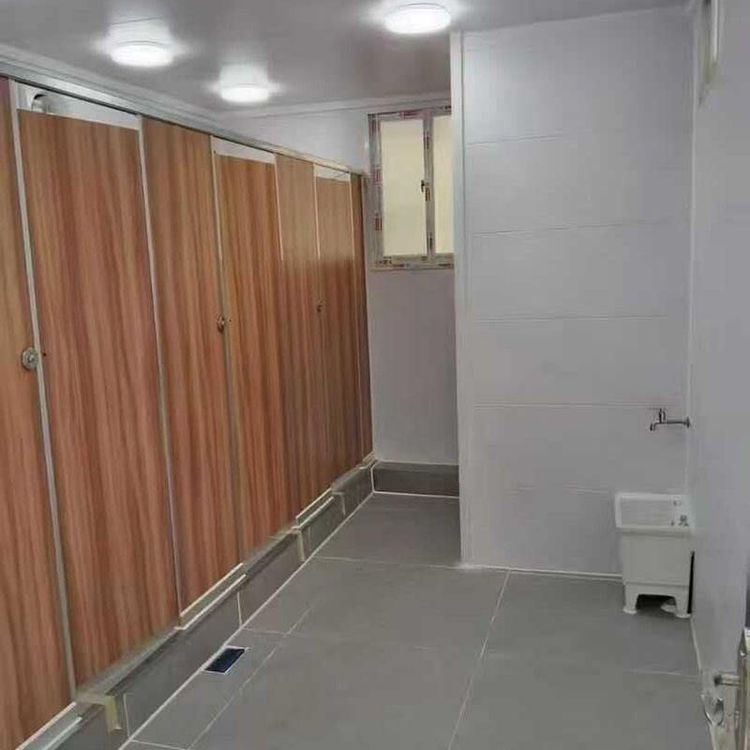
IV. Examples For example, there is a "3 + 1 wood-grain-colored mobile water-flushing direct-discharge toilet", and a 6-row outdoor toilet for scenic spots, campsites, and parks. The overall structure is made of galvanized steel frames with waterproof asphalt tiles on top, which can be moved by hoisting at any time. The toilet and wall panels are of the same color, with stainless steel door locks. Inside the toilet, there are squat toilets, washbasins, exhaust fans, ceiling lights, and other facilities, providing a relatively comfortable toilet environment for users.