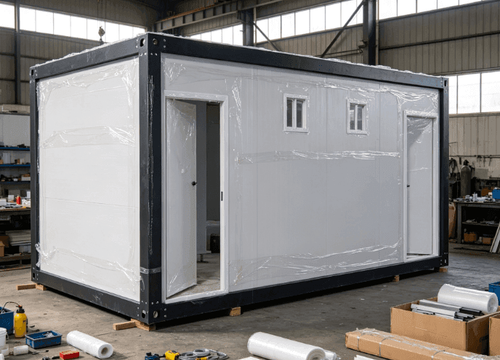
Waterproofing Installation for Prefabricated Slab Houses
Waterproofing installation for prefabricated slab houses requires systematic treatment tailored to their structural characteristics. Traditional local repairs are prone to repeated leakage, necessitating a comprehensive waterproofing and dynamic adaptation approach. The specific implementation points are as follows:

1. Base Layer Treatment: Eliminating Hidden Water Channel Risks
The base layer of prefabricated slab roofs often suffers from defects such as unevenness, sanding, peeling, and honeycomb cracks. These flaws create hidden channels for water infiltration, leading to the failure of the waterproofing layer. Before construction, it is essential to thoroughly remove roof obstructions (such as debris and old waterproofing layers) and use high-strength repair materials for precise treatment of the base layer to ensure a flat, solid, and crack-free surface. For example, when dealing with honeycomb cracks, loose particles should be cleared first, followed by layered filling with polymer cement mortar, and finally grinding to be flush with the original base layer to prevent subsequent leakage caused by base layer defects.
2. Slab Joint Reinforcement: Blocking Continuous Water Infiltration Paths
The slab joints at the拼接处 (splicing points) of prefabricated slabs are high-risk areas for leakage due to displacement and cracking caused by temperature variations and foundation settlement. Rigid filling materials such as epoxy resin or polyurethane sealant should be used for deep reinforcement of the slab joints, with a filling depth exceeding 1.5 times the width of the slab joints to form a continuous waterproofing barrier. Additionally, anti-crack mesh fabric should be added on both sides of the slab joints to enhance the bonding strength between the material and the base layer, preventing the filling material from detaching due to dynamic deformation.
3. Comprehensive Waterproofing: Adapting to Dynamic Deformation Needs
Traditional local repairs or simply laying waterproofing membranes cannot solve the problems of slab joint displacement and water infiltration. It is necessary to use national standard thickened waterproofing membranes (such as SBS modified bitumen membranes) to cover the entire roof, forming a seamless waterproofing layer. The material should possess high tensile and deformation resistance (elongation ≥ 30%) to adapt to the dynamic deformation of prefabricated slab roofs. During construction, the hot-melt method should be used for full adhesion to ensure tight bonding between the membrane and the base layer, avoiding air pockets that could lead to water infiltration.
4. Gutter Reinforcement: Coping with Harsh Conditions
The gutter area is prone to aging and detachment due to water accumulation and ultraviolet exposure, requiring specialized exposed waterproofing techniques for enhanced protection. For example, high weather-resistant waterproofing coatings (such as polyurethane or acrylic coatings) should be applied to the bottom and side walls of the gutter with a thickness of not less than 2mm, and胎体增强材料 (reinforcing fabric) such as non-woven fabric should be added to improve tear resistance. Additionally, R-angles (rounded transitions) should be set at the corners of the gutter to reduce the risk of cracking caused by stress concentration.
5. Construction Standards: Ensuring Long-Term Effectiveness
Abandon traditional patch-up and glue-application methods that only address symptoms and use genuine main materials throughout the construction process, strictly adhering to standardized procedures. For example, after base layer treatment, a closed water test (24 hours without leakage) should be conducted, and after waterproofing layer construction, a pull-off test (bonding strength ≥ 1.5MPa) should be performed. A long-term warranty (such as 5 years) should be provided after acceptance, clearly defining the scope of responsibility to avoid post-construction disputes.
Through systematic treatment, the leakage problems of prefabricated slab houses can be effectively solved, extending the service life of the roof.