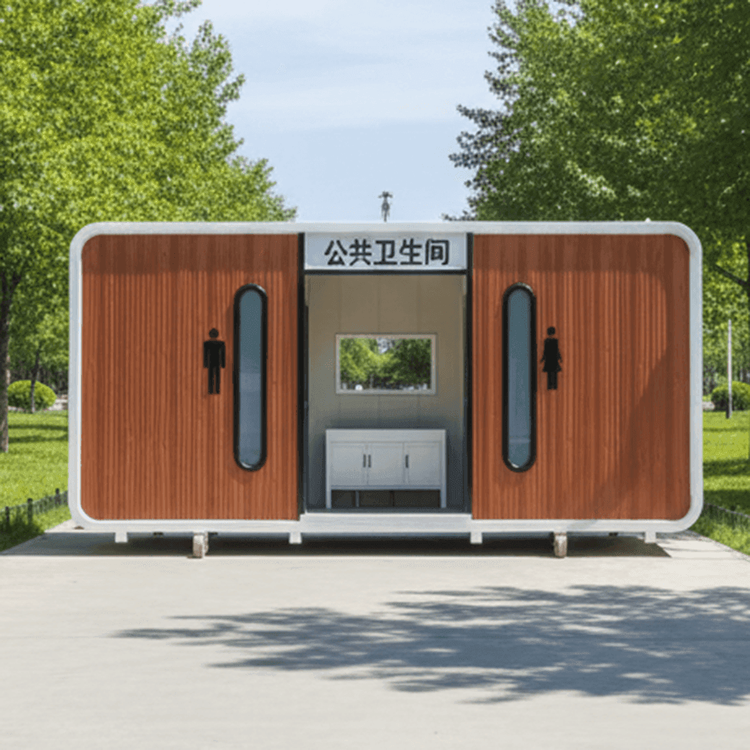
Prefabricated Modules Reshape Policing Space: Sanmen County Traffic Police Brigade "Police Neighbor" Police-Citizen Interaction Platform
Project name: Sanmen County Public Security Bureau Traffic Police Brigade "Police Neighbor" Police-Citizen Interaction Platform
Project type: Modular police service station | Sanmen Police Neighbor | Prefabricated modular space | FRP helmet form
Construction unit: our company
Company website: http://www.ourcompany.com
Contact: 021-60760737
Project design: June 2025
Completion year: December 2025
Project duration: 35 days
Lead designer: Song Xingfeng
Project location: Sanmen County, Zhejiang
Building dimensions: 430048004100mm
Building height: 4.1m
Building type: Prefabricated modular space
Building materials: FRP, aluminum alloy doors and windows, steel structure
When the helmet-shaped "Police Neighbor" police-citizen interaction platform debuted on the streets of Sanmen, few people knew that this "new city landmark"—as striking in looks as it is capable in function—took only 35 days from production to full installation. It is not only a vivid expression of the Sanmen traffic police "Police Neighbor" concept, but also a seamless fusion of industrial design and rapid manufacturing. With an overall size of 4300×4800×4100mm, factory-prefabricated and shipped as a complete unit, every detail faithfully captures the dynamism and strength of a helmet, turning creativity into reality.

I. Inspiration Unlocked: From Traffic Police Helmet to City IP
"Why can't a helmet become a new language for communicating with citizens?"
When the client proposed the "Police Neighbor" platform concept, the core idea locked firmly onto the "helmet." The helmet is the traffic officer's closest "comrade" on daily duty, a concrete symbol of safety and responsibility, and the most intuitive memory point citizens associate with traffic police. Designing the police-citizen interaction platform in the form of a helmet is not only a visual innovation but also an emotional resonance—like a giant "guardian symbol," it tells every passerby that traffic police protection, like a helmet, is always by your side.

The design team did not simply replicate the helmet's exterior. Instead, they found a refined balance between function and aesthetics. The rounded gray shell restores the helmet's streamlined feel; the raised police emblem on top both echoes the helmet structure and reinforces the policing identity; the blue "POLICE" mark and illuminated "Police-Citizen Interaction Platform" lettering maintain a professional look while adding a sense of modern technology. More importantly, this "helmet" is not a cold sculpture but an enterable, interactive space—large windows, an open service counter, and a bright interior layout keep the helmet's recognizability while filling it with the warmth of service.

"What we want is not a 'house that looks like a helmet,' but a 'helmet that can serve,'" the design lead said. "Every curve and every detail must serve the core of 'Police Neighbor,' so that when citizens first see it, they want to approach it and trust it."
II. The 35-Day Extreme Challenge: An Industrial Miracle from Drawing to Reality
When the design was finally approved, everyone faced a practical question: how, within 35 days, could this 4.3-meter-wide, 4.8-meter-long, 4.1-meter-high "helmet" go from drawings to a ready-to-install physical structure?
This was not only a test of manufacturing craft, but an extreme challenge in project management, supply-chain coordination, and precision control. The factory team quickly launched a "rapid prefabrication mode," breaking the entire production process into six stages—design development, structural modeling, material selection, module production, overall assembly, and factory acceptance—with every step timed to the hour.

- Design development: making creativity "manufacturable"
The helmet's rounded surfaces and complex corner structures demanded extremely high production precision. Factory engineers worked closely with the design side, digitally reconstructing every detail with 3D modeling software and turning creative sketches into machinable engineering drawings. From structural load analysis of the overall frame down to the curvature of window frames, everything was repeatedly simulated and optimized to ensure a faithful appearance alongside a solid, durable structure.
- Material selection: safety and quality in equal measure
To restore the helmet's streamlined feel and durability, the factory chose high-strength FRP as the main shell material. Lightweight yet strong, it can easily form the helmet's characteristic rounded surfaces, while offering excellent corrosion and weather resistance for coastal salt spray, wind, and rain. The surface uses automotive-grade baking paint; a fine silver-gray sheen restores a metallic helmet look and makes the whole platform gleam in sunlight. Inside, environmentally friendly flame-retardant materials plus sound and thermal insulation let this "helmet" withstand the elements while offering citizens a comfortable interaction space.
- Module production: break it down, join it with precision
Given the oversized overall dimensions, the factory used a "module prefabrication, overall assembly" production model. The "helmet" was split into four modules—top curved surface, main frame, window modules, and base—each produced separately in the workshop. Every module had its own ID and precision standard, with tolerance within 1 millimeter, ensuring a tight fit at final assembly.
- Overall assembly: the "last mile" of maximum fidelity
Once all modules were complete, the factory entered the most critical overall assembly stage. Engineers joined the top curved surface to the main frame with the precision of assembling intricate Lego, then fitted the window modules and base; every seam was repeatedly finished to ensure visual flow. At the same time, smart equipment, lighting systems, and citizen-service facilities were installed in parallel, turning the "helmet" from an empty shell into a fully functional service station.
From the first design drawing to the complete "helmet" platform leaving the factory, the factory team used industrial precision and efficient coordination to finish the project on schedule. When this large structure was hoisted as a whole onto the transport truck and headed for the streets of Sanmen, everyone knew a brand-new city IP was about to be born.

III. Ready on Arrival: The Power of Prefabrication, Seamless Creative Delivery
What is most striking about the "Police Neighbor" platform is not only the 35-day rapid build, but the innovative model of "factory prefabrication, shipped as a complete unit."
Traditional police booth construction often requires on-site foundation pouring, frame erection, and finishing—long cycles, heavy noise, and impact on the surrounding environment. The "Police Neighbor" platform completely overturns that model: all production, assembly, and commissioning were completed in the factory, including interior workbenches, smart terminals, display screens, and citizen-service facilities—even decorative wall art was already installed.
When it was delivered as a whole to the streets of Sanmen, only foundation docking and external utility connections were needed; it could go into service within a few hours. This "plug-and-play" prefabrication model not only sharply shortened the construction cycle and minimized disruption to citizens' lives, but also pushed design fidelity to the extreme—standardized factory production avoided on-site construction errors, so every curve and every detail of the helmet matched the renderings as closely as possible.

IV. More Than a Building: A Replicable New Paradigm for Policing
The success of the "Police Neighbor" platform lies not only in its creativity and appearance, but in offering a replicable, scalable new paradigm for police services.
The helmet design makes it a traffic magnet on Sanmen streets, drawing citizens to approach and interact; the 35-day rapid prefabrication model allows it to be quickly copied to more intersections and communities, forming a citywide "police-citizen interaction network"; and factory prefabrication with whole-unit delivery ensures every platform maintains consistent quality and function, letting the "Police Neighbor" idea spread from a single point across an entire city.
Today, when citizens enter this helmet-shaped interaction platform to handle business, ask questions, or join traffic safety outreach, they feel not only convenient service but also the warmth of "protection right beside you" that Sanmen traffic police convey through creativity and efficiency. For urban governance, this "helmet" has also become a new model—proving that police services need not be rigid and austere, and can enter people's lives in more creative, citizen-friendly ways.

Epilogue: 35 Days—One Idea Realized, One City's Warmth
From a design sketch to a "steel guardian" on Sanmen streets; from a spark of inspiration to a fully functional police-citizen interaction platform—35 days witnessed not only the speed of industrial manufacturing, but also the Sanmen traffic police commitment to putting people first.
This helmet-shaped "Police Neighbor" platform is a perfect marriage of design and production, a two-way meeting of creativity and efficiency. It tells us that good city services have never been cold buildings, but carriers with warmth and memorable identity. When industrial precision meets human care, truly moving works can be born.
In the future, as more "helmet-style" police-citizen interaction platforms land in Sanmen, the "Police Neighbor" idea will keep spreading, and this city IP born in 35 days will become Sanmen's most striking "safety symbol."