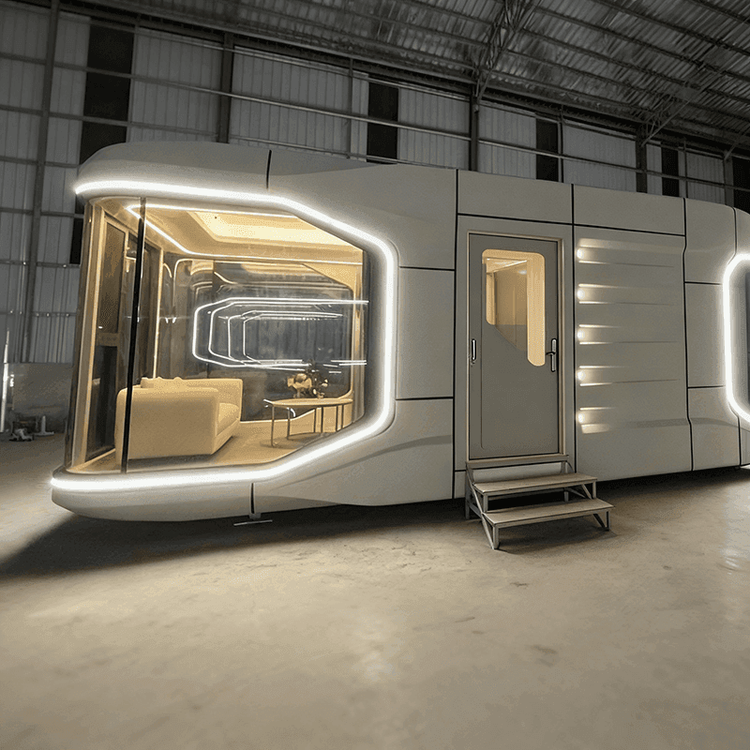
Prefabricated Housing Industry
The prefabricated housing industry is an emerging sector centered around modular construction, achieving efficient construction through factory prefabrication and on-site assembly.

Core Industry Model and Technological Advantages
Modular construction divides buildings into independent modules, with wall, floor, piping, and interior finishing prefabrication completed in factories. On-site, only assembly and connection to utilities are required for the building to be operational. This model transfers over 90% of construction processes to factory assembly lines, enabling standardized mass production. Compared to traditional methods, construction periods are reduced by over 60%, while also minimizing dust emissions, material waste, and on-site labor requirements, offering both energy efficiency and quality control. For example, domestically produced prefabricated houses reduce costs to 30%-50% of traditional overseas construction methods through large-scale production, creating significant cost advantages.
Industrial Chain and Global Layout
China's prefabricated housing industry has established a complete industrial chain, covering steel structures, insulation materials, smart appliances, digital design, and other sectors, forming full-chain service capabilities from BIM modeling and intelligent welding to overseas assembly. Export volume nearly tripled from 2015 to 2025, with a 45% growth rate in the first quarter of 2026. Products are exported to over 150 countries and regions. Ports such as Guangzhou and Shenzhen have become major export hubs, with export volumes increasing by 38.1% and 19.6% year-on-year in the first four months of 2026, indicating strong international market demand.
Application Scenarios and Market Potential
Modular construction is suitable for scenarios such as hotels, apartments, office buildings, hospitals, and data centers, with its flexibility and rapid deployment capabilities meeting diverse needs. Market research institutions predict that the global modular construction market will exceed $142.8 billion by 2030, highlighting the industry's growth potential. With cost advantages and industrial chain integration capabilities, China holds a significant position in the global market.
Development Bottlenecks and Challenges
The industry still faces multiple challenges: Differences in building access standards across countries create trade barriers, and local support capabilities overseas are insufficient. Brand premium capabilities are weak, making it difficult to support high-end markets. Domestically, the design, production, and construction processes are fragmented, with excessive customization in some projects limiting economies of scale and keeping overall costs high. These issues restrict further improvements in the international competitiveness of products.