
Prefabricated House Production
Prefabricated house production involves disassembling buildings into independent modules or components, prefabricating them in factories, and then transporting them to the site for assembly. This process encompasses two main forms: modular construction and prefabricated assembled construction, offering advantages such as short construction periods, controllable quality, and environmental protection and energy conservation. It has been widely applied in multiple fields and has seen export growth.
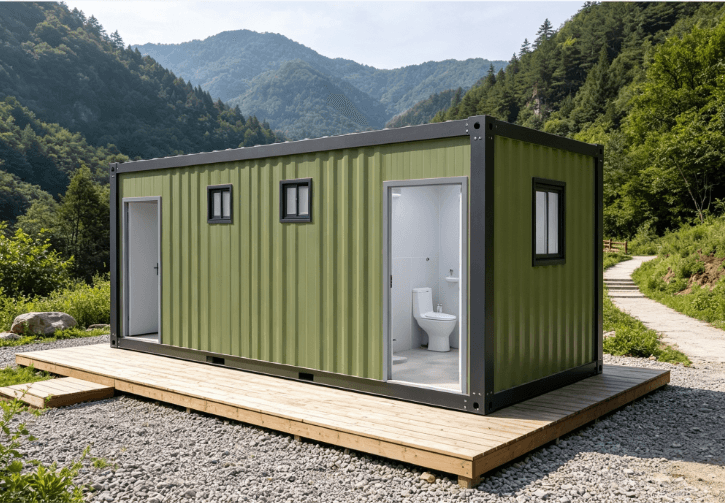
Production Forms and Processes
Prefabricated house production is primarily divided into two categories: modular construction and prefabricated assembled construction. Modular construction involves disassembling buildings into independent unit modules. All processes, including ceiling, floor, water and electricity pipelines, interior decoration, and waterproofing, are completed in the factory. The modules are then manufactured through automated production lines and intelligent management and transported to the site for assembly. For example, the China Construction Hailong Intelligent Construction Industrial Park can deliver 20,000 to 30,000 modules annually through parallel operations and automation technology, reducing the construction period by more than 60% compared to traditional buildings. Prefabricated assembled construction, on the other hand, involves the industrial production of beams, slabs, walls, columns, and other components, which are then assembled on-site. The main types include panel-assembled construction (centered around prefabricated wall panels and floor slabs), box-assembled construction (through the combination of prefabricated functional units), and frame-assembled construction, with technologies covering prefabricated concrete structures and steel structures. Among them, box-assembled construction can increase construction speed by 50%-70%, but it has higher requirements for transportation and lifting equipment.
Production Advantages
The core advantages of prefabricated house production are reflected in three aspects: short construction periods, as factory production and on-site assembly proceed in parallel, significantly reducing the construction cycle; controllable quality, with standardized design ensuring precision (errors controlled in millimeters), and modular construction requiring precise positioning of each steel bar for efficient assembly; environmental protection and energy conservation, reducing dust, noise, and construction waste on-site, meeting the requirements of green buildings. In addition, factory production also reduces reliance on labor. For example, a public housing project in Shenzhen, Guangdong, used 6,028 concrete modules for assembly, reducing on-site labor by about 50%.
Application Scenarios and Market Development
Prefabricated houses have been widely applied in high-end office buildings, hotels, schools, data centers, public housing, and other fields. For example, the completion and delivery period of a public housing project in Shenzhen, Guangdong, was shortened from 2.5-3 years to 1 year. In terms of market development, China's exports of prefabricated houses continue to grow, particularly in the ASEAN market. In the first four months of 2026, the export value of movable houses from the Guangzhou Customs area reached 1.4 billion yuan, a year-on-year increase of 38.1%; the export value of modular houses supervised by the Huangpu Customs reached 548 million yuan, a year-on-year increase of 7.3 times, indicating strong international demand for prefabricated houses.



