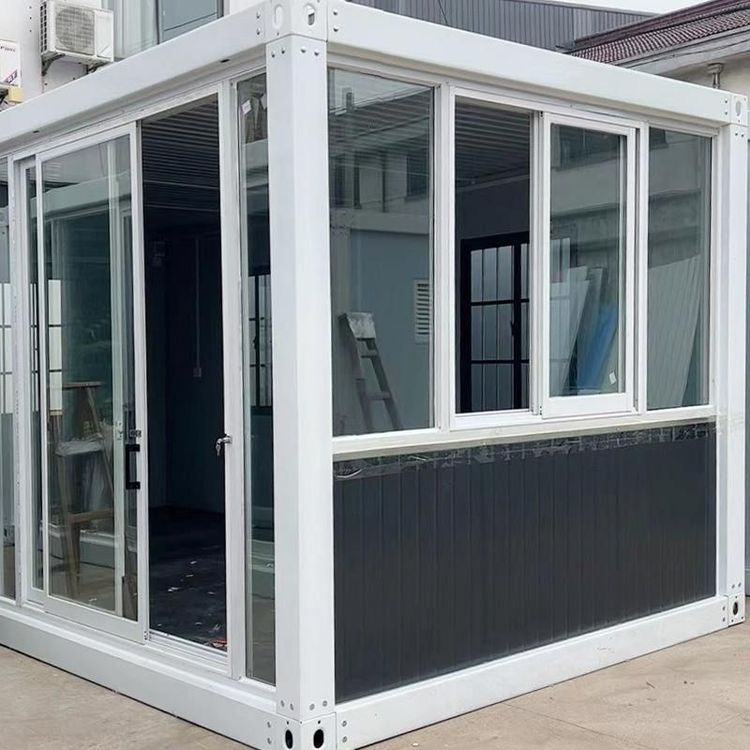
Construction of Pouring Molds for Prefabricated Houses
The construction of pouring molds for prefabricated houses primarily involves the application of cement house molds, with specific construction points as follows:

Mold Preparation
Cement house molds are crucial equipment for shaping concrete prefabricated products. Their core components include mold liners, exterior wall molds, bases, and slide rails. The mold materials are selected from high-strength steel plates combined with reinforcing ribs through welding, or processed from Q235 low-carbon steel. They undergo CNC cutting, precision welding, and surface rust removal and painting treatments to ensure high compressive strength, resistance to deformation, and reusability for over 300 times. Steel molds can achieve a turnover frequency of 300 to 500 times per set. The molds are designed with a modular assembly structure, with tightly fitted components and an assembly precision of ±0.5mm, preventing concrete leakage during pouring and ensuring flat walls and square corners for the cement houses.
Mold Assembly
During construction, the molds must first be assembled and fixed. They support customization of cement house components with spans ranging from 3m to 6m and heights from 2.8m to 3.5m. They can also accommodate the reservation of door and window openings according to specific needs, adapting to various construction scenarios. A single set of molds can be assembled into common cement house sizes such as 3m×6m and 4m×8m, and also supports the customization of irregular modules based on housing layout requirements, offering high flexibility.
Concrete Pouring
For prefabricated insulated cement house molds, steel reinforcement insulation panels must first be placed inside the molds before concrete pouring and compaction to ensure uniform concrete filling and prevent voids or bubbles that could affect component quality.
Curing and Mold Removal
Steam curing processes are employed to accelerate concrete hardening. After curing is complete, the molds can be disassembled and removed. Following mold removal, the components are transported to the site for foundation placement and modular hoisting, with stable connections achieved through sleeve grouting to quickly complete the main structure and decoration.
Cement house molds have undergone four generations of technological upgrades. The fourth generation features a fully automatic hydraulic system integrated with electric vibration functions, allowing for reusability for approximately 5 to 8 years. With wall thicknesses ranging from 14 to 17cm and panel thicknesses from 10 to 13cm, they enable centralized prefabrication of components to shorten construction cycles. A single set of molds can produce 2 to 3 sets of cement house components per day, improving construction efficiency by 40% compared to traditional methods. The production cycle for a single cement house can be controlled within 1 to 2 days, reducing the construction period by 60% compared to traditional methods.