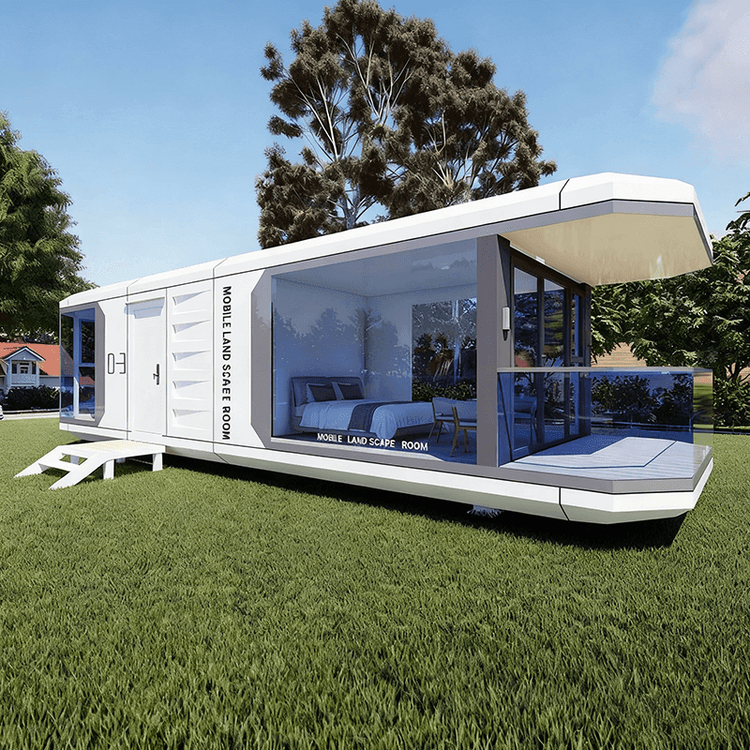
Prefabricated Container Housing
Prefabricated container housing is a form of construction that involves the industrial production of building components and their assembly on-site, with modular construction being a more integrated version of this approach. The following provides an introduction from the perspectives of construction methods, advantages, application scenarios, and market conditions:

Construction Methods:
Prefabricated container housing breaks down buildings into independent modules, with all manufacturing processes completed in factories. Each module includes ceilings, floors, walls, plumbing and electrical systems, and even the waterproofing layer of bathrooms is prefabricated. For example, the CSCEC Dragon Smart Construction Industrial Park in Shenzhen, Guangdong, employs welding robots and highly automated production lines for module assembly. After being transported to the construction site, the modules are assembled to quickly complete the main structure of the building, much like building with "LEGO blocks".
Advantages:
- Short Construction Period: Modular construction adopts a parallel operation model, with factory production and on-site construction occurring simultaneously. Combined with automated vertical warehouses and intelligent production lines, the construction period can be shortened by more than 60%. For instance, a public housing project in Shenzhen used 6,028 concrete modules for assembly, reducing the completion time from 2.5-3 years to just 1 year.
- Controllable Quality: Building quality is controlled according to industrial product manufacturing standards, with design details down to the positioning of each steel bar and errors measured in millimeters, ensuring structural accuracy and stability.
- Energy Efficiency and Environmental Protection: Factory prefabrication reduces on-site casting operations, significantly lowering noise, dust, and construction waste. Fujian Province has established industrial bases with policy support, achieving a reduction in construction waste of over 70% while alleviating traffic congestion.
- Easy Maintenance: Each module comes with an "ID card" recording project name, product model, and production date, facilitating later inspection, repair, and replacement.
Application Scenarios:
The application scenarios of prefabricated container housing continue to expand, covering areas such as public housing, hotels, and senior living apartments. For example, public housing projects in Shenzhen, quick-assembly hotels in Papua New Guinea, and senior living apartment projects in the UK all utilize this technology, demonstrating its flexibility in meeting different needs.
Market Conditions:
China's exports of prefabricated housing have grown significantly. According to customs data, in the first four months of 2026, the export value of movable housing in the Guangzhou Customs area reached 1.4 billion yuan, a year-on-year increase of 38.1%, indicating international market recognition of China's industrialized construction products.