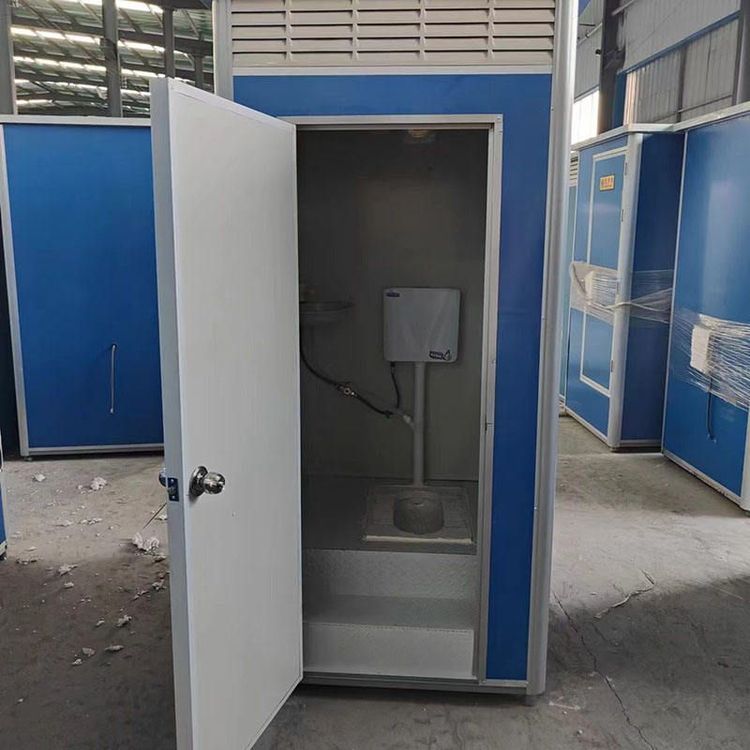
PE Mobile Toilet Injection Molding Machine
Currently, there is no specific equipment information directly targeting the 'PE mobile toilet injection molding machine', but technical analysis can be conducted through the correlation between PE injection molding technology and the production of mobile toilet components.

Suitability of PE Material for Mobile Toilets
PE (polyethylene) is widely used in the manufacturing of mobile toilets due to its corrosion resistance, impact resistance, and ease of processing. For example, components such as storage tanks, sewage pipes, and outer shells of mobile toilets often use PE material, achieving integrated molding through injection molding technology. This process ensures uniform wall thickness, high dimensional accuracy, and high production efficiency, making it suitable for mass production of small and medium-sized structural parts.
Application of Injection Molding Technology in the Production of Mobile Toilet Components
Injection molding technology involves melting PE pellets at high temperatures and injecting them into a mold for cooling and shaping, enabling the production of components with complex shapes. For mobile toilets, injection molding machines need to meet the following conditions:
- Material Adaptability: PE has a wide melting temperature range (approximately 180-280°C), requiring injection molding machines to have precise temperature control systems to prevent material decomposition or insufficient fluidity.
- Mold Design: Mobile toilet components (such as pipe connectors and shell clasps) require high-precision molds to ensure sealing and assembly compatibility. For example, PE pipe fittings molds provided by Taizhou Huangyan Leiao Mould Co., Ltd. can produce standard pipe connectors.
- Production Efficiency: Mass production requires injection molding machines with moderate clamping force and fast injection speeds to shorten the molding cycle. Although the fully automatic extruder from Qingdao Jiahe Plastic Machinery Co., Ltd. is primarily used for pipe production, its extrusion-injection molding linkage technology can indirectly support the continuous manufacturing of some components.
Limitations of Existing Equipment
Currently, PE injection molding machines on the market (such as pipe fitting injection molding machines and general-purpose injection molding machines) are mostly designed for scenarios like pipes and daily necessities, requiring adaptation to the specific needs of mobile toilet components:
- Size Limitations: Large mobile toilet shells may require ultra-large injection molding machines, while most equipment has a clamping force concentrated in the range of 500-3000 tons, necessitating custom molds or split molding.
- Functional Expansion: Some components need to integrate structures such as reinforcing ribs and sealing grooves, requiring optimization of mold runner design to reduce weld lines.
Conclusion: Although there is no dedicated 'PE mobile toilet injection molding machine', by selecting suitable PE injection molding equipment, customizing molds, and combining automated production lines, the manufacturing of mobile toilet components can be efficiently completed. It is recommended to contact mold manufacturers (such as Leiao Mould) or equipment suppliers (such as Qingdao Jiahe) for customized solutions based on specific component sizes and production volume requirements.