Sliding Door Design in Park Restrooms
The application of sliding doors in park restroom design primarily involves dynamic adjustments in tidal restrooms, spatial optimization in mobile restrooms, and improvements in management mechanisms, with the core goal of enhancing usage efficiency and spatial utilization.

Sliding Door Design in Tidal Restrooms: Dynamic Adjustment of Toilet Resources
The "tidal restroom" at West Lake Scenic Area in Huizhou, Guangdong, achieves dynamic conversion of toilet functions through movable signs or lockable sliding doors. During peak hours, management staff temporarily adjust the male and female restroom areas using physical partitions (such as iron gates), for example, converting some male toilet stalls into female ones to alleviate queuing issues for women. This design relies on the lockability and rapid switching capability of the sliding doors to ensure that the adjusted areas are secure and not prone to accidental operation. For instance, the original signs might cause functional confusion due to visitors moving them randomly, so the scenic area plans to upgrade to fixed slot-type signs and optimize the locking mechanism of the sliding doors to prevent accidental touches or human interference.
Application of Sliding Doors in Mobile Restrooms: Space Saving and Structural Adaptation
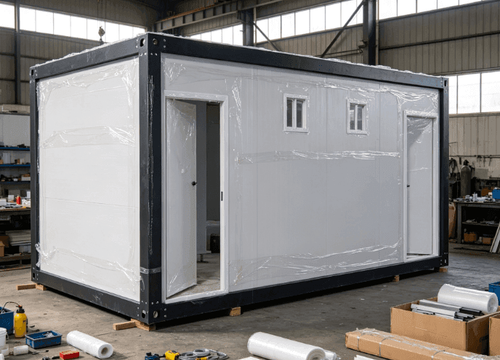
Mobile restrooms, which require frequent movement or modular assembly, have higher structural requirements for doors. The mobile restrooms produced by Dezhou Hongtu Metal Products Co., Ltd. use aluminum alloy sliding doors, which offer the advantage of saving horizontal space and avoiding the additional area occupied by the opening radius of traditional swing doors, making them particularly suitable for narrow spaces. Additionally, the "double-door" design of the new Chinese-style imitation wood-grain mobile restrooms, although not explicitly stated as sliding doors, can be inferred to potentially optimize space utilization through bidirectional opening or combine sliding and swing characteristics to adapt to different scenarios.
Management Improvements for Sliding Doors: Enhancing Safety and User Experience
In response to the management pain points of sliding doors in tidal restrooms, the scenic area proposes two improvement measures: first, upgrading the movable signs to fixed slot-type signs to reduce sign confusion caused by visitor misoperation; second, optimizing the locking mechanism of the sliding doors, such as adopting more secure locks or electronic control systems, to prevent accidental opening of the doors due to crowd pressure during peak hours. These improvements aim to balance the flexibility of dynamic adjustments with the safety of the usage process, ensuring that the sliding doors meet functional requirements while reducing maintenance costs and user inconveniences.
In conclusion, the design of sliding doors in park restrooms needs to balance functionality, spatial efficiency, and management convenience. Through material selection, structural optimization, and upgrades to management mechanisms, it achieves dual improvements in resource dynamic allocation and user experience.