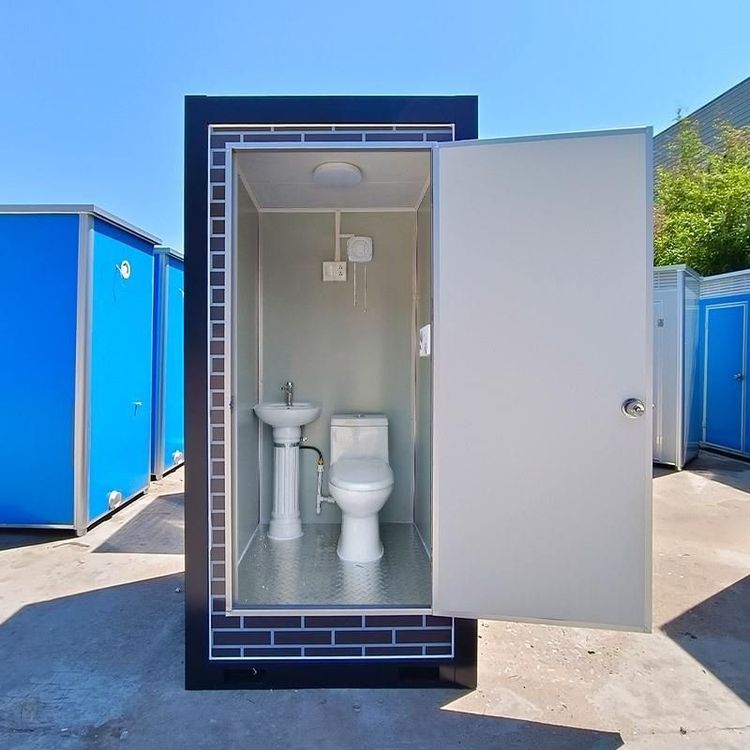
Outdoor Portable Toilet Ventilation Fan
The design and application of outdoor portable toilet ventilation fans require consideration of key factors such as power matching, duct layout, odor filtration, intelligent monitoring, and equipment type selection.

1. Power Matching for Ventilation Equipment Select exhaust equipment power based on the number of toilets and the size of the space. For a single portable toilet, it is recommended to configure a small exhaust fan with a power of ≥5W to ensure basic ventilation needs. For large toilets used by multiple people, a dual-fan parallel design can be adopted to achieve an air exchange rate of 8-10 times per hour, preventing odor accumulation due to confined spaces. Insufficient power leads to low ventilation efficiency, while excessive configuration may increase energy consumption and noise.
2. Duct Layout and Airflow Optimization The design of exhaust ducts should follow the principle of "short, straight, and few bends" to reduce ventilation resistance. For rental scenarios with multiple toilets arranged side by side, a centralized exhaust main duct can be used for connection, with each branch duct equipped with an air volume control valve for independent control. For example, at large event venues, the control valves can prioritize enhanced ventilation for toilets with high usage frequencies, avoiding resource waste.
3. Odor Filtration System Configuration Relying solely on exhaust is insufficient to completely solve odor problems; a filtration device must be installed in front of the exhaust fan. It is recommended to use activated carbon filter pads or photocatalytic filter screens. The former removes odor molecules through adsorption, while the latter decomposes organic matter through photocatalytic reactions. When renting, attention should be paid to the filter replacement cycle, and preference should be given to washable materials (such as activated carbon filter screens with metal frames) to reduce long-term usage costs.
4. Intelligent Monitoring and Emergency Response For large event scenarios, air quality sensors can be configured to monitor odor concentration in real-time. When the concentration exceeds the standard, the exhaust system is automatically activated, forming a closed-loop control. At the same time, an emergency plan should be formulated. For example, in extreme weather or power outages, a backup power interface (such as a UPS uninterruptible power supply) should be used to ensure continuous equipment operation, preventing deterioration of sanitary conditions due to power failures.
5. Applicability of Induction Exhaust Fans Microwave induction exhaust fans automatically switch operating states by detecting human presence duration and automatically power off when people leave. Such equipment is suitable for outdoor portable toilets, reducing ineffective operating time and extending equipment lifespan. However, attention should be paid to the matching of its induction range (usually 3-5 meters) with the toilet layout to avoid ventilation interruptions due to induction blind spots.