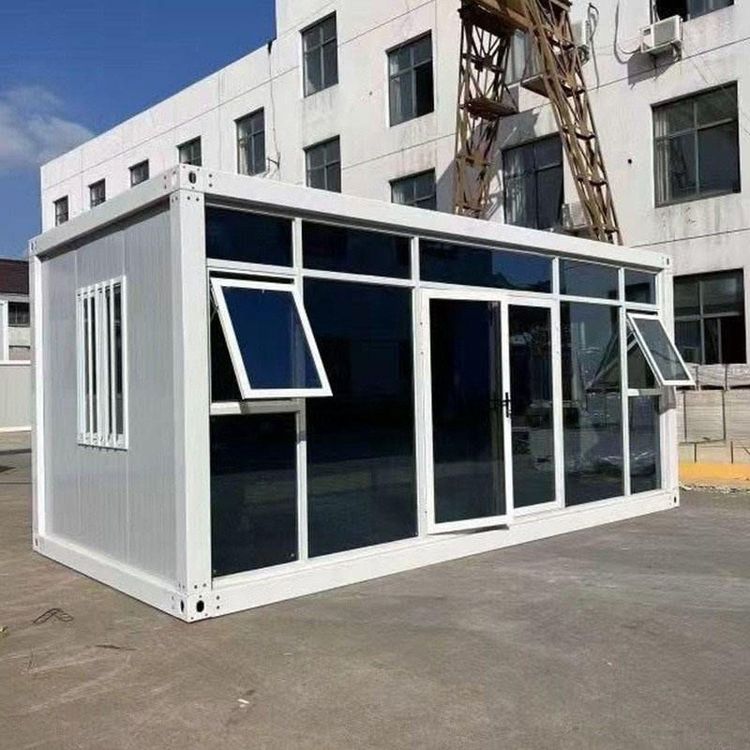
Outdoor Mobile Toilet House
Outdoor mobile toilet houses are facilities that can be moved as a whole, providing toilet services for the public and customers, suitable for both fixed and temporary needs. Here is a detailed introduction from aspects such as types, structures, mobility methods, and sewage treatment methods:

Diverse Types: Outdoor mobile toilet houses produced by different companies each have their own characteristics. The four-squat-position mobile toilet from Dezhou Hongtu Metal Products Co., Ltd. is 4 meters long and 2.3 meters wide, with a pointed roof. Its exterior walls are made of heat-insulating metal carved panels. The men's toilet is equipped with two squat positions, a urinal, and a column basin, and costs less than 20,000 yuan. The mobile toilet container house from Suzhou Xinchao Yue Integrated Housing Co., Ltd. is detachable and serves as an integrated mobile house for temporary toilets, bathrooms, and shower rooms on construction sites. The exportable detachable mobile toilet container house with a shower from Shandong Weichang New Building Materials Co., Ltd. can also be used as a dormitory for construction site workers. Guangzhou Xingang Steel Structure Housing Co., Ltd. offers towed space capsule mobile houses, capsule cabins, and movable toilets, among others. The container mobile house from Yiwu Haoju Trading Firm can be used as a toilet in scenic spots and a bathroom in parks.
Structural Composition: A mobile toilet generally consists of a fecal sewage storage tank (or fecal sewage treatment device), floor slab, sanitary ware, walls, washing equipment, water tank, roof, and mobility device. These components work together to ensure the normal use and functionality of the mobile toilet.
Structural Forms: Mobile toilets can be divided into single-structure mobile toilets and composite-structure mobile toilets based on their structural forms. Single-structure mobile toilets are relatively independent and have a simpler structure; composite-structure mobile toilets may combine multiple functions or materials and have a more complex structure.
Mobility Methods: Mobile toilets can be divided into lifting and handling mobile toilets and powered and towed mobile toilets based on their mobility methods. Lifting and handling mobile toilets require external equipment for movement; powered and towed mobile toilets have their own power or can be moved by towing, making them more flexible to use.
Sewage Treatment Methods: Mobile toilets can be divided into water-flush and waterless-flush suction mobile toilets, circulating water-flush mobile toilets, and dry-packing mobile toilets based on their sewage treatment methods. Different treatment methods are suitable for different environments and needs. For example, water-flush toilets are suitable for places with a water source, while dry-packing toilets are more suitable for water-scarce areas or areas with high environmental protection requirements.