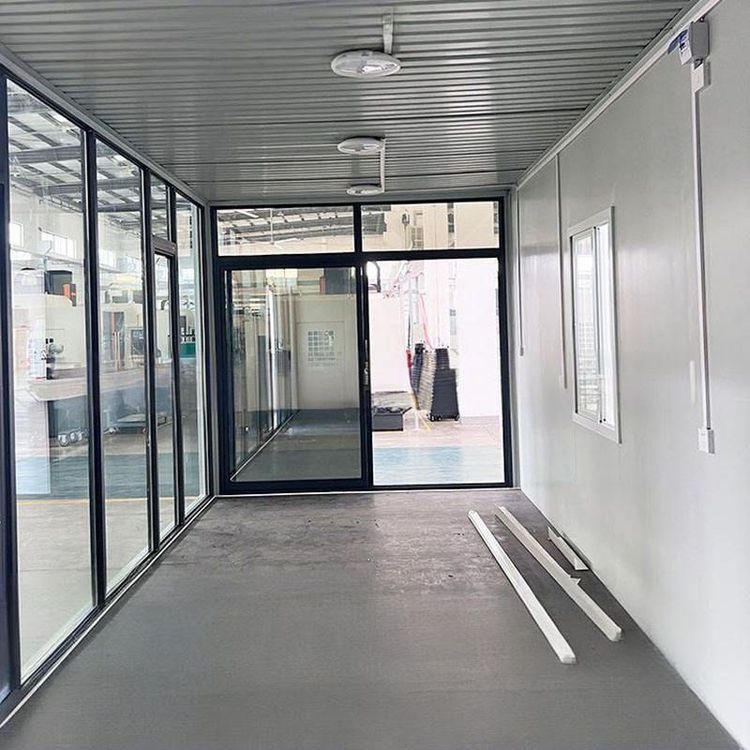
Outdoor Mobile Cement Toilet
An outdoor mobile cement toilet is a movable and flexibly deployable public sanitation facility suitable for various outdoor scenarios, featuring diverse structures and flexible waste treatment methods.

Materials and Structure
The materials and structure of mobile cement toilets vary according to design requirements. Some products use steel structures or foam boards as the main framework, with wall materials including color-coated steel sheets, fiberglass-reinforced plastics, stainless steel, and metal carved panels, offering both durability and portability. For example, the four-stall toilet produced by Dezhou Hongtu Metal Products Co., Ltd. features an exterior wall made of thermally insulating metal carved panels, which adapts well to outdoor environments and enhances user comfort. Its structure is typically frame-based, supporting hoisting needs for easy overall movement or on-site assembly. Core components include fecal wastewater storage tanks (or treatment devices), flooring, sanitary fixtures, water tanks, roofs, and mobile units, with some products also integrating washing facilities to form a complete functional unit.
Types and Classifications
Based on structural form, mobile toilets are divided into single-unit structures (independent units) and composite structures (multi-unit combinations). By mobility method, they can be classified as hoisting-type, handling-type, and powered towing-type, adapting to different transportation conditions. Wastewater treatment methods include water-flushing, non-water-flushing suction, recirculating water-flushing, and dry-packing types. For example, water-flushing toilets require matching water tanks and sewage pipes, suitable for locations with a water supply; dry-packing toilets collect feces in biodegradable bags, requiring no water or electricity, making them ideal for remote areas or temporary events.
Features and Advantages
- Mobility: Prefabricated in factories for quick on-site installation, these toilets can be flexibly relocated according to site needs, avoiding resource waste from fixed facility relocation.
- Diverse treatment methods: Appropriate technologies can be selected based on environmental constraints (e.g., water supply, sewage conditions), such as recirculating water-flushing for water conservation or dry-packing for locations without sewage pipes.
- Small footprint: Compared to traditional public toilets, mobile toilets are compactly designed, occupying less land resources, making them particularly suitable for space-limited locations.
- Combination of aesthetics and practicality: While meeting functional requirements, attention is paid to exterior design, such as pointed roofs and metal carved panel exteriors, enhancing visual appeal.
Application Scenarios
Widely used in population-dense areas such as train stations, docks, tourist attractions, large construction sites, and squares. For example, during the May Day holiday in 2026, Shanxi's Jinci Scenic Area reallocated buses as mobile men's toilets, converting fixed men's toilets into women's toilets, increasing daily reception capacity by approximately 67% and effectively alleviating peak tourist pressure.
Price Range
Prices vary significantly based on brand, specifications, and functionality. For example, the new rural mobile toilet from Guangdong Maoming Hengjian costs about 10,500 yuan per set, the large cement septic tank from Fujian Nanping costs about 3,200 yuan per set, the旱厕 (dry toilet) renovation product from Shandong Liaocheng costs as low as 700 yuan per set, and the four-stall scenic area toilet from Dezhou Hongtu can be purchased for less than 20,000 yuan.