Prefabricated Housing in Ordos City
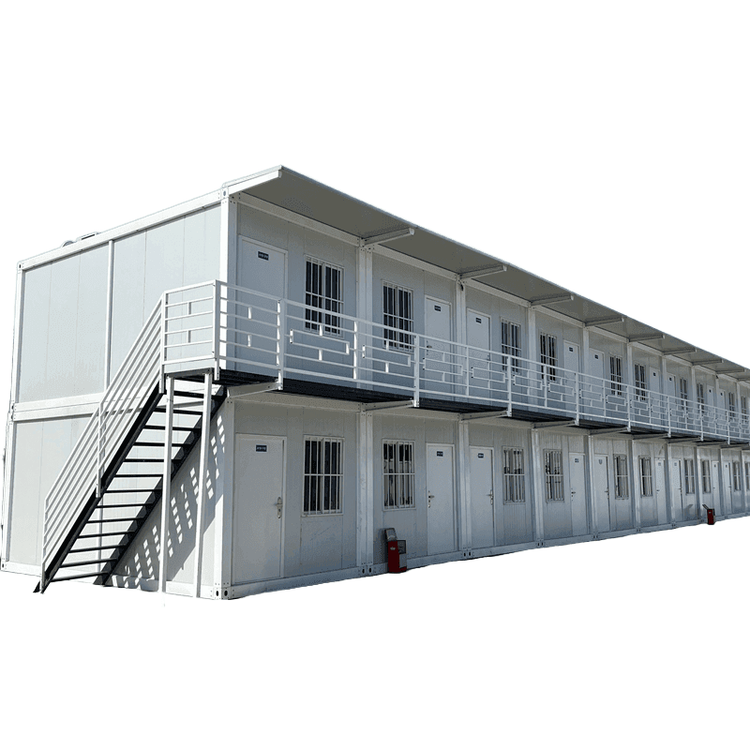
Prefabricated housing in Ordos City mainly includes integrated prefabricated concrete houses, and the development of prefabricated buildings is rapid, along with procurement projects for adding color-steel roofs to cement prefabricated houses.

Integrated Prefabricated Concrete Houses: These houses are primarily made of cement-based materials and are produced as integrated modules through molds, covering wall panels, floor slabs, and roofs. Reinforcement placement, concrete pouring, and curing are completed in the factory. The material mix focuses on frost resistance and wind erosion resistance, with specific admixtures added to enhance the durability of the concrete. Modules are mostly connected using mechanical fastening or specialized grouting materials to ensure integrity. Compared to traditional on-site poured concrete houses, they reduce on-site wet work; compared to brick-and-mortar houses, they have a shorter construction period; and compared to light steel structure houses, they are heavier but can optimize sound insulation and thermal insulation through composite design. Construction speed is usually faster than traditional buildings because modules are produced in parallel in the factory, and only foundation work and lifting assembly are required on-site. The main installation of a small residential building may be completed in a few days, while traditional brick-and-mortar structures take several weeks. Initial investment may be higher than some traditional structures due to factory production and transportation costs, but the maintenance cost over the entire lifecycle is low. Cement materials have good weather resistance and are not prone to corrosion or insect damage. In Ordos, with abundant local cement resources, the overall cost ranges from several hundred to over a thousand RMB per square meter, depending on the design and configuration. They are suitable for rural and pastoral residential buildings, tourism facilities, or temporary housing, with sturdiness to withstand strong winds and sandstorms in the area. The modular design facilitates adaptation to different needs. Prefabricated production reduces on-site construction waste and dust, but cement production has high energy consumption and carbon emissions. However, compared to traditional brick-and-mortar structures, resource utilization is higher, and although recycling is slightly inferior to new environmentally friendly material houses, they have strong durability and are suitable for long-term use. They can also be optimized for energy efficiency by combining with local climate conditions.
Adding Color-Steel Roofs to Cement Prefabricated Houses: There are relevant procurement projects, with the project number 2026 - JJDKBC - G4013. The announcement period is from July 17, 2026, to July 21, 2026. The first-place winner in the evaluation results is Ningxia (omitted), and the second-place winner is Gansu (omitted). It also explains the suppliers that failed the qualification and compliance reviews.
Development of Prefabricated Buildings: In 2024, the newly started construction area of prefabricated buildings in the city reached 1.55 million square meters, accounting for nearly 30% of newly built buildings. There are 4 autonomous region-level prefabricated building industrial bases, 2 autonomous region-level pilot projects, and 2 high-assembly-rate projects successfully recognized, forming a full industrial chain cluster of design, production, and construction in the city's core area. It is expected that by the end of 2025, prefabricated buildings will account for 30% of newly built buildings.