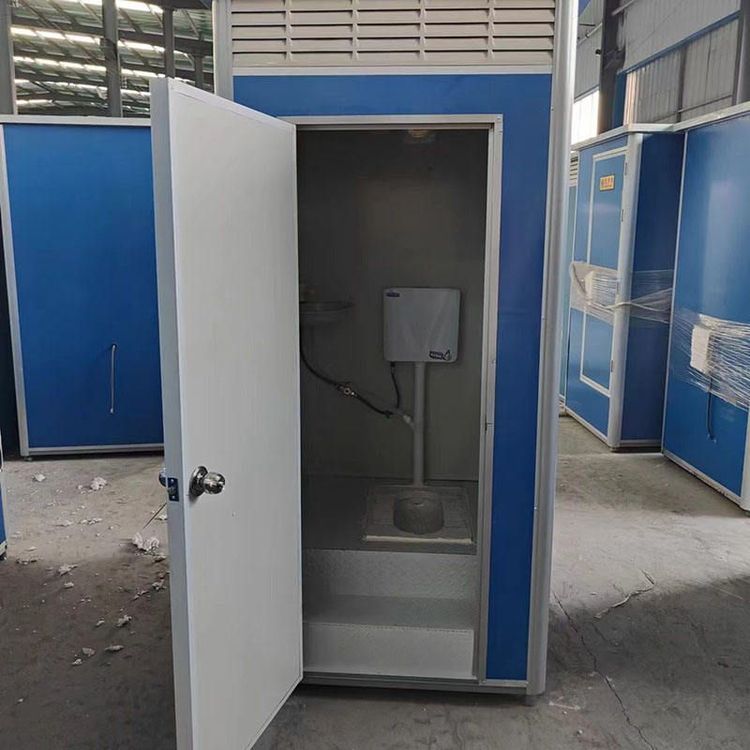
No-Squat Large Mobile Toilet
No-squat large mobile toilets generally fall under the category of barrier-free mobile toilets, designed primarily to meet the needs of individuals with mobility impairments. They possess the following characteristics:

Structural Form
No-squat large mobile toilets often adopt a composite structure, with main materials such as fiberglass and polyethylene that are lightweight yet durable. These materials not only reduce the overall weight, facilitating easy movement and repeated assembly and disassembly, but also effectively resist corrosion and aging, extending the toilet's service life. Their structural design supports modular assembly, allowing for adjustments in scale according to actual needs, and adapting to temporary or long-term deployment in various scenarios.
Functional Configuration
Inside the toilet, traditional squat positions are replaced with sit-down toilets, and barrier-free facilities are added for special populations. For example, safety handrails are installed on both sides of the sit-down toilet to assist users in getting up or maintaining balance; an emergency call device is equipped to ensure timely contact with external rescue in case of emergencies; an automatic sensor flushing system is adopted to reduce manual operations and lower the difficulty of use. Some high-end models may also include additional details such as non-slip floors and low-positioned handwashing basins to further enhance safety and convenience.
Spatial Design
The internal space layout adheres to barrier-free technical standards, ensuring that wheelchairs can freely enter and turn around. The door width is typically not less than 90 centimeters to meet wheelchair passage requirements; the sit-down toilet is positioned at a reasonable distance from the door to avoid collisions; the internal clear height is generally not less than 2.2 meters to avoid a sense of oppression. Additionally, sufficient space is reserved in the aisles and operational areas to facilitate assistance from accompanying personnel.
Mobility Methods
Depending on their size, no-squat large mobile toilets are divided into hoisting and transporting types and powered towing types. The hoisting type is lifted and transported as a whole by lifting equipment, suitable for short-term, high-frequency movement scenarios (such as large construction sites); the powered towing type is equipped with a towing device and can be towed by a vehicle to the designated location, making it more suitable for long-distance, cross-regional deployments (such as tourist attractions or temporary events). Both methods support rapid installation and disassembly, minimizing the impact on the site.
By eliminating squat positions and incorporating barrier-free technical standards, these toilets effectively address the toilet needs of the elderly, disabled individuals, pregnant women, and other groups. They are widely used in public places such as large construction sites, squares, and tourist attractions, embodying a unity of humanization and functionality.