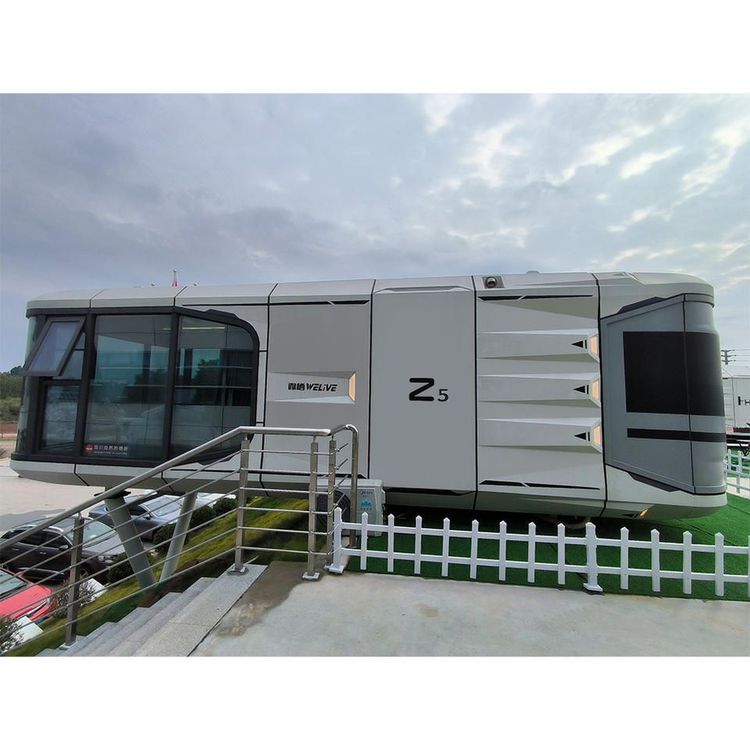
Multi-story Container Modular Building
A multi-story container modular building is a movable, reusable modular structure developed based on container house technology, capable of multi-story assembly, with the specific structural type depending on the application scenario.

1. Basic Definition and Characteristics
Multi-story container modular buildings use standardized containers as basic units, enabling rapid assembly through steel frame structures and bolt connections. Their core advantages lie in modular design and mobility. Individual containers can be used independently or stacked vertically to form multi-story buildings, meeting the needs for temporary or long-term residence and office space. This building form is commonly found in construction site dormitories, emergency shelters, commercial exhibition halls, and other scenarios, characterized by short construction periods, controllable costs, and strong environmental protection.
2. Structural Types and Applicability
According to reference information, container houses can be divided into three categories, two of which may be suitable for multi-story assembly:
- Traditional Cargo Container-Modified Container Houses: These are directly modified from discarded shipping containers, retaining the original steel structure of the cargo containers. Windows, doors, and internal partitions are added through cutting and welding. Such houses have strong load-bearing capacity, but the spatial layout is limited after modification, and additional foundation reinforcement is required for multi-story stacking, typically suitable for 2-3 story buildings.
- Newly Welded Container Modular Houses: These use newly welded steel frames, with customizable container sizes and internal layouts. Such houses have higher structural stability, and their overall strength can be enhanced by adding vertical supports and connectors for multi-story assembly, suitable for buildings over 3 stories, but with relatively higher costs.
- Demountable Container Modular Houses: These are mainly composed of light steel structures, with containers that can be completely disassembled into components for transportation and assembled on-site. Although highly flexible, they have weak load-bearing capacity and are generally only used for single-story or low-rise buildings. Multi-story assembly requires careful evaluation of structural safety.
3. Key Technologies for Multi-story Assembly
To achieve stable assembly of multi-story container modular buildings, the following issues need to be addressed:
- Foundation Treatment: Concrete foundations or steel structure supports need to be designed according to geological conditions to ensure overall anti-overturning capability.
- Connection Method: High-strength bolts or welding processes are used to fix the frames between containers, and horizontal supports and diagonal braces are added to enhance lateral stability.
- Load Distribution: By reasonably arranging the positions of containers, local overload-induced structural deformation can be avoided.
4. Application Scenarios and Limitations
Multi-story container modular buildings are suitable for projects with high requirements for construction speed and strong site temporariness, but attention should be paid to:
- Planning Approval: Some regions have strict regulations on the number of stories and uses of temporary buildings, requiring prior confirmation of compliance.
- Long-term Use: If long-term use is required, regular inspections of connectors and steel structure corrosion are necessary, and anti-corrosion measures should be taken.